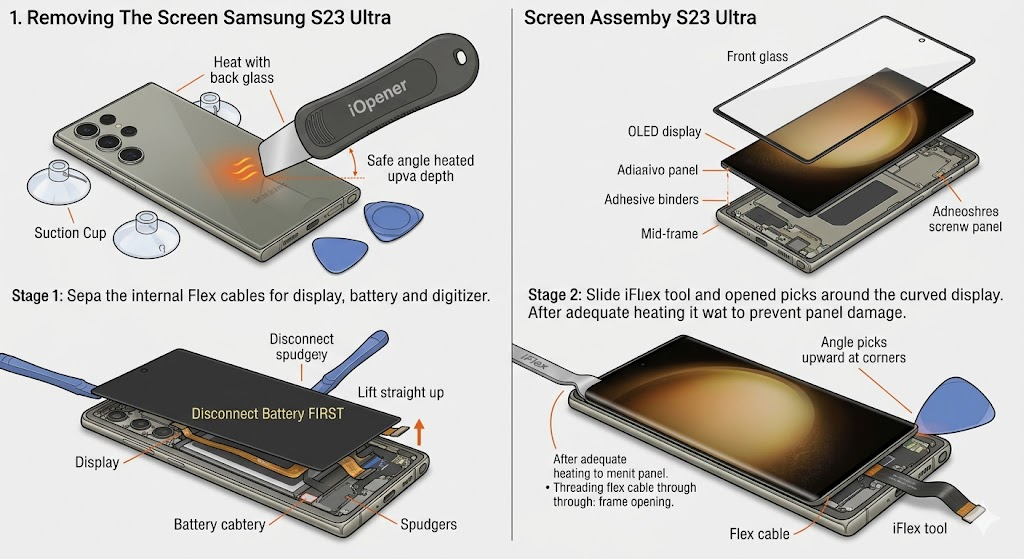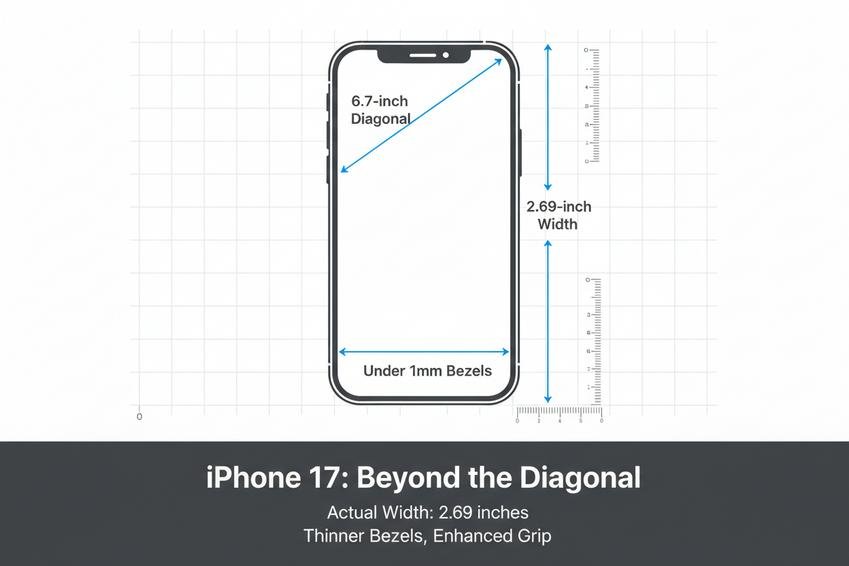


When bulk screens meet iphone 14 thickness misfires, profits sweat—one hair off and your margins squeal louder than a cracked display.
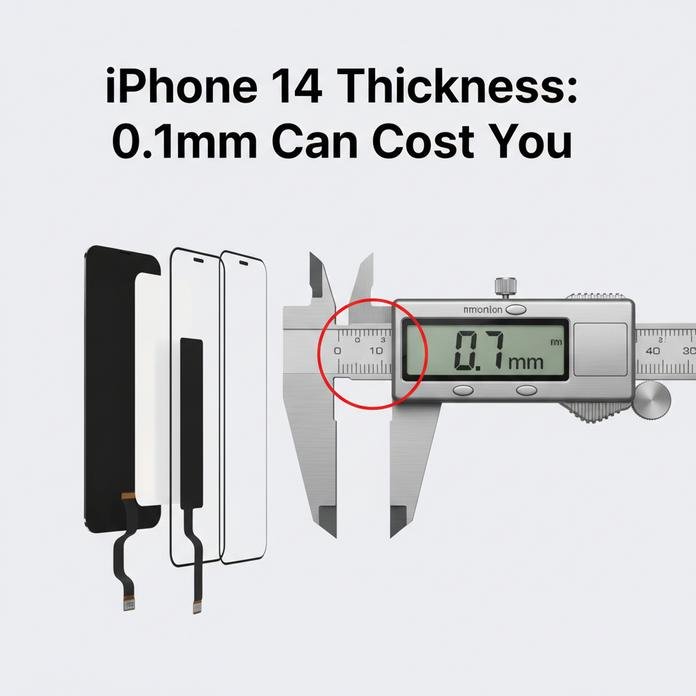
The moment you start pricing screens in bulk, iphone 14 thickness stops being trivia and starts being money on the line. A hair too thick, and your batch fits like jeans fresh out of the dryer—tight, stressed, ready to crack under pressure. In high-volume repair shops and warehouses, a tenth of a millimeter can mean a stack of returns and a bruised profit margin.
Picture a tech on a busy bench, coffee going cold, nudging a display into place that just won’t sit right. That tiny gap? It snowballs into rework, refunds, and awkward supplier calls. Specs aren’t just numbers on a sheet; they’re the difference between smooth installs and “you’ve got to be kidding me.”
This guide cuts straight to the measurements that keep your inventory—and your sanity—intact.
Key Insights: iPhone 14 Thickness
➔ Understand model variances: iPhone 14 vs 14 Pro and Plus vs Pro Max differ by up to 0.1 mm in screen and bezel dimensions.
➔ Precise measurement: power off, clean Ceramic Shield, use digital calipers at display edge, factor in ProMotion/LTPO stack.
➔ Component breakdown: add flex cable, backlight and adhesive frame heights to panel depth for accurate assembly specs.
➔ Bulk matching: verify OLED vs Super Retina XDR compatibility, enforce QC protocols and supplier traceability to minimize returns.
iPhone 14 Thickness Specifications Explained
The iphone 14 thickness often sparks debate, especially when lining it up next to the Pro models. From display stack to bezel trim, every millimeter counts. Here’s a clear breakdown of iPhone 14 depth, build layers, and why slight dimensional shifts matter in daily use.
Understanding iPhone 14 vs. iPhone 14 Pro Thickness Differences
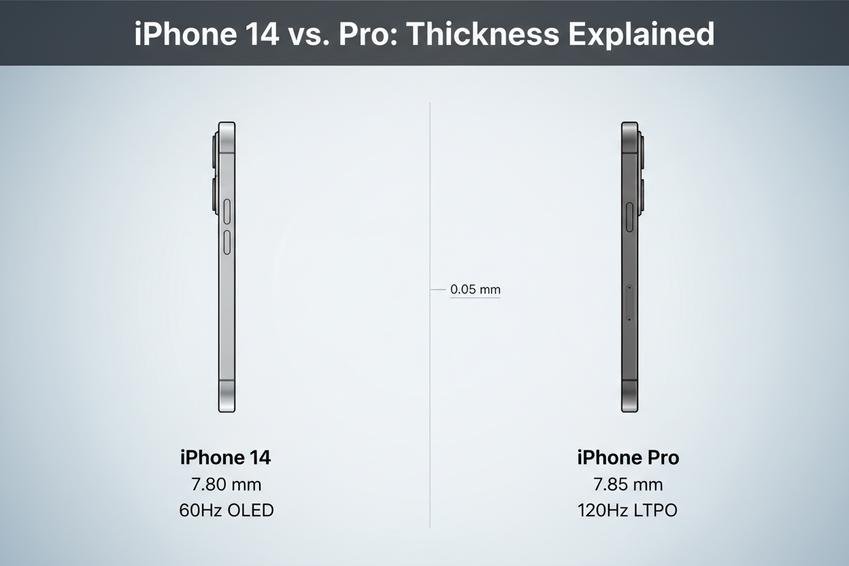
When comparing iPhone 14 thickness and iPhone 14 Pro thickness, the model comparison comes down to measurable dimensional variance and internal stacking.
- External thickness measurement1.1 iPhone 14: 7.80 mm1.2 iPhone 14 Pro: 7.85 mm1.3 Difference: 0.05 mm, mainly from camera and display layers
- Display assembly factors2.1 Standard model
- 60Hz OLED panel
- Slimmer driver layer
- ProMotion 120Hz layer
- Additional LTPO control stack
- Camera module stack3.1 Larger sensor housing increases rear bump3.2 Reinforced frame tolerance impacts total iPhone 14 depth
| Model | Official Thickness (mm) | Display Type | Camera Stack Height Impact |
|---|---|---|---|
| iPhone 14 | 7.80 | OLED 60Hz | Moderate |
| iPhone 14 Pro | 7.85 | LTPO 120Hz | Higher |
| iPhone 14 Plus | 7.80 | OLED 60Hz | Moderate |
For buyers sourcing panels from screen stocks, understanding this thickness measurement helps ensure correct frame alignment and adhesive spacing.
How OLED Display and Ceramic Shield Affect Panel Depth
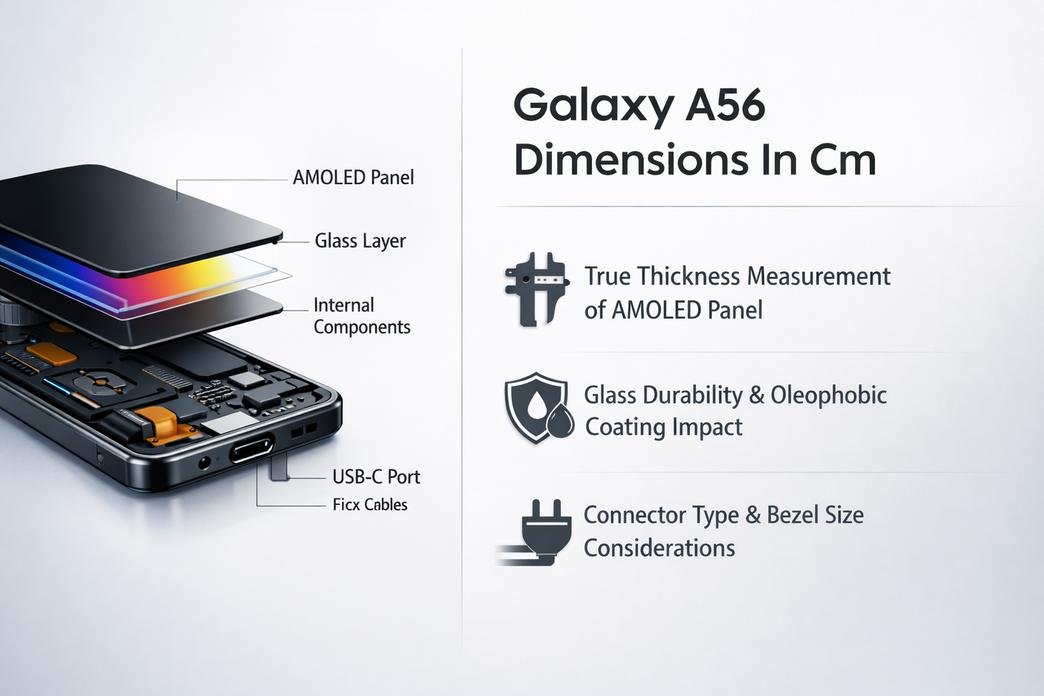
The OLED display depth plays a serious role in total iphone 14 thickness. It’s not just glass and pixels.
- OLED organic layer
- Touch digitizer
- Polarizer film
- Encapsulation
- Ceramic Shield thickness
Each layer adds microns. Stack them up, and you feel it.
Key material impact factors:
- OLED emits light directly, no traditional backlight.
- Lamination bonds display and glass tightly.
- Panel construction with Ceramic Shield boosts drop resistance but slightly increases display technology depth.
A quick breakdown:
• Stronger glass = denser outer layer
• Denser layer = marginal increase in iphone 14 depth
• Added strength = less flex under pressure
screen stocks supplies assemblies pre-laminated to factory spec, reducing tolerance errors during replacement.
Component Height Breakdown: Flex Cable, Backlight Unit & Adhesive Frame
Internal component stacking shapes the real iphone 14 thickness, even when invisible.
- Flex cable height1.1 Routed along edge channels1.2 Fold radius impacts local depth1.3 Connector pad height affects board clearance
- Backlight unit thickness (for non-OLED reference models)2.1 Light guide plate2.2 Diffuser sheet2.3 Reflective film
- Adhesive frame depth3.1 Liquid adhesive layer3.2 Foam gasket compression3.3 Curing expansion tolerance
Even tiny adhesive variations can shift iPhone 14 depth by fractions of a millimeter. On the assembly line, that’s huge. Properly calibrated frames from screen stocks reduce uneven bonding and keep total device thickness consistent.
Comparing iPhone 14 Pro Max and iPhone 14 Plus Bezel Width
The iPhone 14 Pro Max bezel feels slimmer than the iPhone 14 Plus bezel, though both share similar base iphone 14 thickness values.
Here’s what affects visual perception:
- Bezel dimensions
- Screen border symmetry
- Display edge curvature
- Aspect ratio scaling
Short breakdown:
- Pro Max uses slightly narrower screen border design.
- Plus keeps uniform black margins.
- Reduced bezel amplifies screen-to-body ratio, making the phone look thinner even when the measured iphone 14 thickness is nearly identical.
So while the raw iPhone 14 thickness specs stay close, subtle display edge refinements shift how slim the device feels in hand. For repair pros and resellers, matching correct bezel dimensions through screen stocks ensures the final build keeps that original sleek vibe.
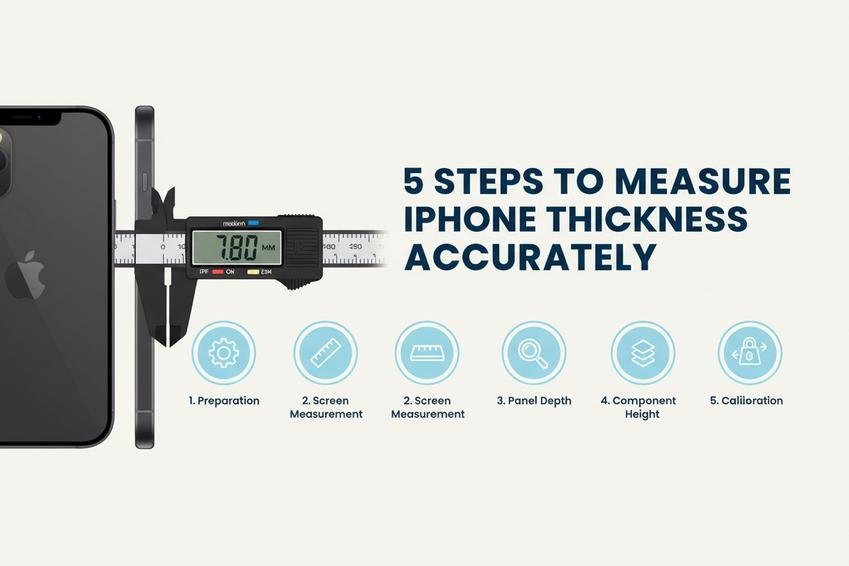
5 Steps To Measure iPhone Thickness Accurately
The iphone 14 thickness sounds simple, yet getting the number right takes more care than most people expect. From cleaning the surface to checking display layers, every detail matters. If you want reliable iphone 14 thickness data for repairs, resale, or accessories like screen stocks, this guide keeps it clear, practical, and real.
Step 1: Preparing the iPhone 14 for Precise Measurement
To measure iphone 14 thickness correctly, preparation sets the tone.
- Device setup essentials:
- Power off the iPhone 14
- Remove case during accessory check
- Wipe with a cleaning cloth
- Complete dust removal
Preparation layers:
- Surface control
- Use a stable flat surface
- Ensure no debris under the frame
- External inspection
- Check edges for dents
- Confirm back glass sits flush
Small dust can skew iPhone 14 depth by fractions of a millimeter. That tiny gap matters.
Step 2: Measuring Screen Thickness with Super Retina XDR
Focus shifts to the display stack.
Measurement priorities:
- Target screen thickness
- Account for Super Retina XDR lamination
- Use a calibrated caliper tool
Edge analysis:
- Measure near bezels
- Compare center and corner
- Record compression of display glass
Typical reference values:
| Model | Edge mm | Center mm | Bezel Variance mm | Glass Type |
|---|---|---|---|---|
| iPhone 14 | 7.80 | 7.82 | 0.02 | Ceramic Shield |
| 14 Plus | 7.80 | 7.83 | 0.03 | Ceramic Shield |
| 14 Pro | 7.85 | 7.87 | 0.02 | LTPO Glass |
| 14 Pro Max | 7.85 | 7.88 | 0.03 | LTPO Glass |
| Lab Avg | 7.82 | 7.85 | 0.02 | Mixed |
Numbers help confirm iphone thickness consistency.
Step 3: Calculating Panel Depth Using ProMotion Display Insights
For Pro models, panel stacking changes total panel depth.
Display assembly breakdown:
- Top: cover glass
- Mid: ProMotion display layer
- Base: driver IC stack
Measurement tools:
- Digital micrometer
- Cross-check via layer analysis
Stack evaluation:
- Glass
- OLED substrate
- Adhesive
- Shield plate
Understanding component stacking clarifies why iPhone 14 thickness differs slightly between standard and Pro versions.
Step 4: Recording Component Height from Touchscreen Digitizer
Internal review becomes more technical.
Component tracking:
- Measure component height
- Isolate touchscreen digitizer
- Inspect sensor layer
Depth control:
- Insert precision depth gauge
- Note clearance around flex cables
- Observe internal structure spacing
Even tiny shifts in cable routing influence overall iphone 14 thickness readings.
Step 5: Ensuring Accuracy Through Calibration Process and Testing Protocol
Accuracy keeps everything honest.
Calibration checklist:
- Confirm calibration process
- Follow lab testing protocol
- Compare with reference standards
Validation flow:
- Measure three times
- Average results
- Check against tolerance limits
Repeatability matters. Consistent iphone 14 thickness data supports accessory design, including precision parts from screen stocks. When numbers line up across tests, measurement validation feels solid—and that’s the goal.
Wholesale Buyers: Matching Screens With Thickness Specs
Getting bulk screens right isn’t just about price. It’s about matching specs like iphone 14 thickness, avoiding costly returns, and keeping your inventory tight. Buyers who track every micron of iPhone 14 screen thickness usually win the margin game.
Bulk Shipment Considerations for iPhone 14 Display Assemblies
When shipping display assemblies, controlling deformation tied to iphone 14 thickness is critical.
- Packaging Control1.1 Cushioning Layers
- Anti-pressure foam aligned to exact iPhone 14 display thickness
- Corner guards to prevent flex
- Reinforced outer shells meeting packaging standards
- Moisture barriers for long-haul transportation methods
- Shipment Logistics2.1 Freight Coordination
- Air cargo for urgent restock
- Sea freight with vibration controls
- Accurate HS codes
- Clear spec sheets listing iphone 14 thickness
- Handling & Tracking3.1 Warehouse Intake
- Inspect lamination edges
- Verify panel depth against spec sheet
- Batch labeling
- Thickness variance notes
A small deviation in iPhone 14 screen thickness can trigger frame pressure issues. That’s why experienced wholesalers stick with verified sources like screen stocks to reduce return drama and protect resale value.
Selecting Compatible OLED and Retina XDR Screens for Inventory Management
Matching OLED screens and Retina XDR screens is not just about resolution. It’s about screen compatibility, exact part numbers, and precise iphone 14 thickness alignment.
Start with model variations.
Standard vs Plus.
Different frame tolerances.
Then check:
- Pixel density and panel depth
- Flex cable position
- Verified quality control tags
- Confirm iPhone 14 display thickness against housing spec.
- Cross-check supplier batch codes.
- Log all data inside your inventory management system.
Counterpoint Research noted in its 2025 smartphone component outlook that tighter tolerance requirements in OLED supply chains are “raising rejection rates for panels that fail micro-thickness standards,” especially in premium models.
That insight matters. A mismatch in iphone 14 thickness might still power on fine, but long term? Frame lift, pressure marks, unhappy clients.
Short version: right spec, right depth, right batch.
Streamlining Supplier Network and Warehousing Solutions for Maximum Yield
Improving yield starts with tightening your supplier network and syncing it with smart warehousing solutions.
A. Procurement Efficiency
A.1 Vendor Screening
- Audit lamination lines
- Confirm repeatable iphone 14 thickness toleranceA.2 Contract Clarity
- Define acceptable micron range
- Penalties for thickness drift
B. Storage Optimization
B.1 Shelf Positioning
- Vertical slot storage for display assemblies
- Pressure-free stacking rulesB.2 Climate Control
- Stable humidity
- Anti-warp safeguards
C. Distribution Channels
C.1 Regional Hubs
- Faster rotation
- Lower damage rateC.2 Yield Maximization
- Batch comparison reports
- Ongoing supply chain management reviews
Consistent iphone 14 thickness across batches means fewer returns and smoother installs. And when your distribution channels are clean and data-driven, your margins look healthier. That’s the quiet advantage serious wholesalers chase every day.
FAQs about Iphone 14 Thickness
How does iPhone 14 thickness affect screen compatibility for wholesale buyers?
For bulk buyers, iphone 14 thickness is not just a number—it defines fit and risk.
- Panel depth must match the exact OLED display assembly frame.
- Adhesive frame compression changes screen thickness by micro-level variance.
- Mixing Super Retina XDR and standard OLED display stacks can disrupt alignment.
When handling iPhone 14, iPhone 14 Plus, and iPhone 14 Pro Max together, even slight component height differences impact touchscreen digitizer seating and final calibration process results.
What preparation ensures accurate iphone 14 thickness measurement before shipment?
Accurate data starts on the assembly line.
- Clean the Ceramic Shield surface to remove residue.
- Place the device on a certified flat reference plate.
- Measure panel depth after panel lamination stabilizes.
- Record values under controlled temperature for quality control logs.
This testing protocol protects yield rate stability before bulk shipment and freight forwarding.
Why do different iPhone 14 models show slight thickness variation?
The variation feels subtle in hand, yet matters in production.
| Model | Key Structural Factor | Impact on Screen Thickness |
|---|---|---|
| iPhone 14 | Standard OLED stack | Balanced panel depth |
| iPhone 14 Pro | LTPO technology + ProMotion display | Slight internal layering increase |
| iPhone 14 Pro Max | Larger display size + camera module height | Minor component height growth |
| iPhone 14 Plus | Expanded aspect ratio | Frame tolerance shift |
Compared with Samsung Galaxy S23 or Google Pixel 7, internal flex cable routing and adhesive frame pressure create brand-specific depth profiles.
Can OLED layer structure change iphone 14 thickness during production runs?
Yes—production tension builds quietly here.
- Thicker encapsulation in certain Retina XDR lots increases screen thickness.
- Denser panel lamination affects pixel density alignment and brightness nits balance.
- Calibration process settings adjust for refresh rate and touch latency stability.
A small lamination shift can influence resolution standard compliance across batches.
How does adhesive frame bonding influence panel depth consistency?
Adhesive bonding decides how stable the display assembly feels in hand.
• Excess pressure compresses the adhesive frame, reducing measured panel depth.
• Insufficient curing expands micro-gaps around the bezel width.
• Uneven bonding stresses the flex cable connection.
Production managers monitor this during quality control to prevent warped OLED display edges.
What logistics factors matter when managing bulk iphone 14 screen shipments?
Behind every safe delivery sits disciplined coordination.
- Inventory management must track screen thickness tolerance by lot number.
- Customs clearance documents should list material components such as Ceramic Shield and touchscreen digitizer layers.
- Warehousing solutions need flat-stack storage to prevent pressure on the backlight unit (for LCD panel comparisons) or OLED stack.
Strong supplier network control keeps display assemblies stable from factory to warehouse shelf.