

In the iPhone screen wholesale world, one bad batch kills trust—because invisible repairs aren’t magic, they’re your reputation’s lifeline.
In 2026, iPhone screen wholesale isn’t a price game—it’s a trust fall. One bad batch, and your customer’s phone loses True Tone, Face ID glitches, and suddenly your shop’s name is mud. That “invisible repair” everyone talks about? It’s the difference between a phone that feels factory-fresh and one that screams aftermarket the second you unlock it.
A repair should be like good stage magic: no trapdoors showing, no wires hanging out. When True Tone shifts or Face ID stalls, customers notice fast. Returns pile up. Margins shrink. Reputation takes the hit.
As a senior display engineer at BOE noted in a 2025 SID industry panel, “Calibration integrity is the new quality control.” DSCC’s 2025 OLED market report echoes the shift—premium panel demand keeps climbing as refurb channels chase OEM-level performance.
High-end buyers know the score. Invisible repair isn’t fancy talk; it’s survival.
Key Points: The Invisible Art of iPhone Screen Wholesale
➔ Streamlined Logistics: Efficient customs clearance, optimized freight and diversified distribution mitigate delays and seasonal fluctuations.
➔ Rigorous Quality Control: Comprehensive testing of brightness, touch responsiveness, True Tone calibration and Face ID sensor alignment ensures defect-free, OEM-grade units.
➔ Invisible Repair Techniques: Micro-weld assembly tools and premium display modules achieve seamless, factory-fresh screen restorations with no visible joints.
➔ Expert Training & Support: Specialized technician certification, model-specific protocols and dedicated technical assistance maintain installation precision and cross-model compatibility.
➔ Strategic Sourcing: Long-term supply agreements and manufacturer-direct partnerships stabilize pricing, secure vendor reliability and confirm part-number accuracy.
➔ OEM vs. Aftermarket Balance: Weigh cost advantages of aftermarket parts against the consistent performance and durability of OEM-grade modules.
4 Challenges In High-End iPhone Screen Wholesale
High-end iPhone screen wholesale sounds simple, yet bulk display trade hides real operational pressure.
Customs Clearance: Streamlining Bulk OLED Panel Imports
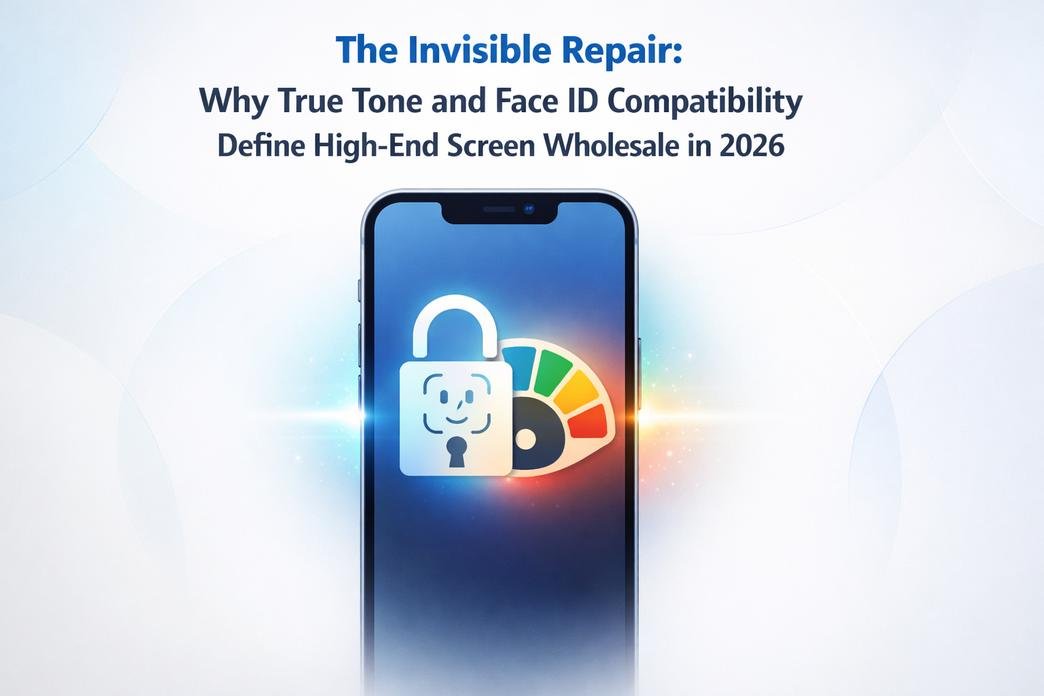
In iPhone screen wholesale, customs can slow cash flow fast. To keep iPhone screen bulk orders moving:
- Documentation Control
- Match invoices with customs regulations codes.
- Verify component traceability for each OLED lot.
- Logistics Alignment
- Coordinate global distribution schedules with freight agents.
- Standardize packaging standards to prevent inspection flags.
- Risk Buffer
- Track lead times weekly.
- Pre-clear high-volume iPhone display wholesale shipments.
Miss one detail, and warehouse intake stalls. Tight paperwork keeps iPhone screen wholesale margins healthy.
Rigorous Testing to Guarantee Defect-Free Units
Quality sells in iPhone screen wholesale. Buyers expect zero drama.
Testing workflow in iPhone screen bulk supply:
- Core Display Metrics
- Measure pixel density and backlight uniformity.
- Inspect optical clarity and viewing angles.
- Functional Accuracy
- Calibrate via display calibration tools.
- Sync ambient light sensor with True Tone Functionality Restoration data using programming tools.
- Durability Review
- Check touch responsiveness.
- Assess oleophobic coating wear.
- Run structured durability testing cycles.
Solid quality control protects every iPhone screen wholesale shipment and keeps wholesale iPhone screens competitive.
Mitigating Seasonal Fluctuations in Global Distribution
Demand swings hit iPhone screen wholesale hard, especially during launch seasons.
To steady iPhone display wholesale operations:
- Inventory Tiering
- Core models: steady inventory management.
- New releases: flexible buffer stock.
- Supplier Strategy
- Ongoing supplier vetting.
- Backup sourcing for OLED and mini-LED displays.
- Market Watch
- Track refresh rates trends and OLED technology upgrades.
- Monitor repair data for under-display cameras.
When iPhone screen wholesale planning matches market trends and future display manufacturing processes, cash flow feels less like a roller coaster.
Securing Vendor Reliability with Long-Term Supply Agreements
Stable sourcing keeps iPhone screen wholesale predictable.
Agreement structure for wholesale iPhone screens:
- Technical Safeguards
- Protect original display data integrity.
- Ensure flex cable integrity for Face ID alignment.
- Validate infrared camera, dot projector, and flood illuminator compatibility for biometric authentication via secure enclave pairing.
- Commercial Terms
- Locked pricing tiers.
- Clear quality benchmarks tied to iPhone screen bulk KPIs.
- Ongoing Review
- Quarterly audits.
- Firmware updates for evolving display characteristics.
Strong partnerships make iPhone screen wholesale less risky and far more scalable.
Invisible iPhone Screen Repair Tech
Precision matters in iPhone screen wholesale, especially when clients expect factory-level results without visible repair traces.
Invisible Joints with Micro-Weld Assembly Tools
In high-volume iPhone screen wholesale, invisible bonding defines quality.
- Core Process1.1 Micro-alignment of OLED and glass1.2 Targeted micro-soldering on flex cables1.3 Precision heat mapping via diagnostic equipment
- Integration Control2.1 Secure component transfer from original assembly2.2 Fine-tuned programming tools for touch IC pairing2.3 Strict repair protocols for stable signal flow
• Cleaner seams
• Stable touch response
• Reduced light leakage
For buyers sourcing iPhone screen wholesale, this means seamless integration that looks untouched—exactly what serious wholesale iPhone screen distributors demand.
Premium-Quality Display Modules: Seamless OEM-Grade Repairs
Reliable iPhone screen wholesale depends on strict OEM specifications.
A. Display Standards
A1. Color mapping aligned to factory display calibration
A2. Verified component compatibility across models
A3. Batch-tested against evolving repair industry trends
B. Quality Control Chain
B1. Incoming material inspection
B2. Pixel integrity scan
B3. Frame pressure tolerance test
- No uneven backlight
- No color drift
- No ghost touch
Suppliers like screen stocks focus on certified aftermarket parts that mirror OEM feel. In the iPhone screen wholesale market, consistent grading keeps returns low and trust high.
Specialized Training for Expert Repair Technicians
Good tools mean little without skill.
Technician Development Path:
1) Device Architecture
- Dot projector alignment
- Infrared camera safety positioning
- Proximity sensor recalibration
2) Biometric Protection
- Maintain biometric authentication chain
- Safeguard secure enclave data links
3) Final Verification
- Full facial recognition test
- Front camera module clarity check
For iPhone screen wholesale buyers, certified handling reduces post-install risk. That’s why professional wholesale iPhone screen partners prioritize trained benches over rushed labor.
In-House Refurbishment Materials for Flawless Screen Restorations
High-end iPhone screen wholesale isn’t just about swapping panels. It’s controlled restoration.
Workflow Breakdown:
I. Panel Recovery
I.a Preserve display panel structure
I.b Stabilize ambient light sensor window
II. Function Recovery
II.a Restore True Tone Functionality Restoration via display calibration
II.b Match original display characteristics using adaptive software algorithms
III. Performance Tuning
- Fine brightness adjustment
- Verified color accuracy
♢ Sustainable material reuse
♢ Controlled bonding pressure
As iPhone screen wholesale scales, suppliers that combine sustainability practices with tight process control—like screen stocks—set the pace for future-ready iPhone screen wholesale operations.
Why Prioritize True Tone Repair Compatibility?
True Tone isn’t just a feature; it protects color accuracy and overall user experience, especially in the competitive iPhone screen wholesale market.
Ensuring True Tone on Retina Displays Across Generation Variants
In iPhone screen wholesale, model matching isn’t casual—it’s layered:
- Version Identification1.1 Match display code to logic board.1.2 Sync with ambient light sensor data flow.1.3 Confirm firmware alignment for stable display calibration.
- Sensor Communication Chain2.1 Retina panel reads light shifts.2.2 Sensor feeds tone data.2.3 System adjusts white balance instantly.
- Repair Validation
- Run post-screen replacement diagnostics.
- Recheck brightness balance.
- Confirm natural tone recovery.
For buyers in iPhone screen wholesale, skipping variant checks risks washed tones and broken True Tone sync.
OEM-Grade Parts: Guaranteeing Accurate Color Calibration
Quality matters in iPhone screen wholesale, especially when handling bulk iPhone screens.
Core technical stack:
- Panel Integrity1.1 OEM glass layer thickness consistency.1.2 Stable OLED or LCD backlight output.1.3 Preserved factory display calibration profile.
- Color Management2.1 Maintain factory color accuracy delta values.2.2 Balance dynamic white balance shifts.2.3 Protect long-term brightness uniformity.
- Repair Industry Impact
- Reduces return rates.
- Protects shop credibility.
- Supports steady iPhone screen wholesale pricing tiers.
Counterfeit panels often pass visual checks but fail under calibration tools. That’s bad for business and worse for the customer holding the phone.
Manufacturer-Direct Sourcing for Device Compatibility Confirmation
Reliable iPhone screen wholesale starts upstream.
Compatibility control works like this:
- Component Verification1.1 Cross-check part numbers.1.2 Validate connector layout.1.3 Inspect component integrity under quality control protocols.
- System Integration2.1 Ensure biometric authentication remains stable.2.2 Confirm facial recognition via aligned front camera module.2.3 Protect security features tied to the display circuit.
- Market Alignment
- Meet evolving market demand.
- Track updated technical specifications.
- Strengthen supply reliability.
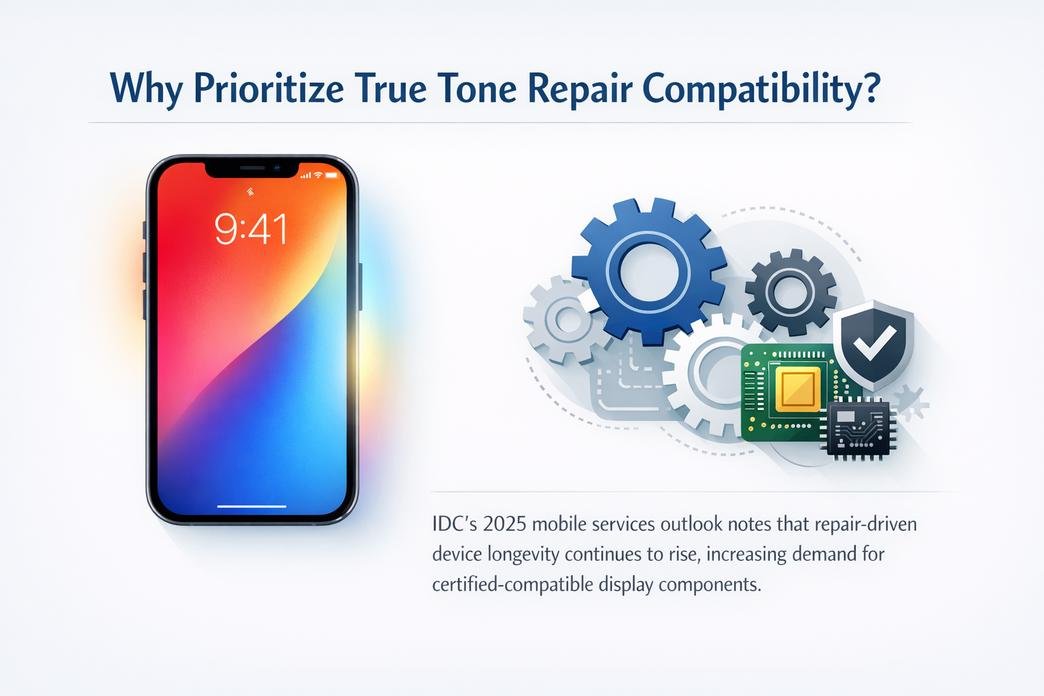
IDC’s 2025 mobile services outlook notes that repair-driven device longevity continues to rise as consumers delay upgrades, increasing demand for certified-compatible display components.
That’s exactly why many repair businesses sourcing iPhone screen wholesale partner with screen stocks—direct sourcing cuts mismatch risks and keeps device compatibility tight. In wholesale iPhone screen supply, precision isn’t optional; it’s survival.
How Secure Is Face ID Integration?
Face ID security matters in every iPhone screen wholesale deal, especially when performance and privacy sit on the line.
Rigorous Testing: Ensuring Defect-Free Face ID-Enabled Modules
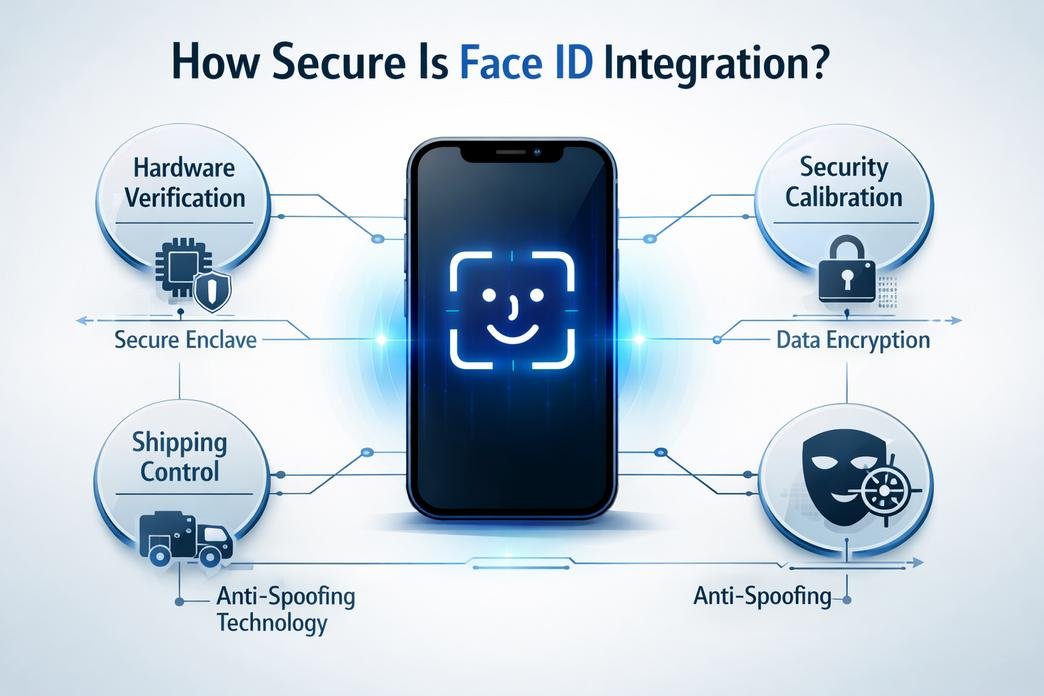
In iPhone screen wholesale channels, Face ID stability depends on tight layered validation:
- Hardware Verification1.1 Sensor grid alignment with hardware-software integration checks1.2 Dot projector precision review using facial recognition algorithms1.3 Infrared module isolation to protect biometric authentication
- Security Calibration2.1 Secure enclave handshake confirmation2.2 Data encryption pathway stress testing2.3 Anti-interference scans for anti-spoofing technology
- Shipping Control for iPhone screen wholesale bulk orders3.1 Batch-level defect scanning3.2 Serial trace logging for privacy safeguards
For screen stocks, tight control keeps iPhone screen wholesale clients confident and returns low.
Verifying Generation Variants to Maintain Part Number Integrity
Generation mismatch can break Face ID in iPhone screen wholesale inventory, so verification runs deep:
- Variant Mapping1.1 Model-to-panel cross-check1.2 Flex cable coding review1.3 Firmware pairing for hardware-software integration
- Authentication Layer2.1 Chip binding tied to secure enclave2.2 Sensor ID sync for stable biometric authentication2.3 Encrypted handshake validation through data encryption
- Wholesale Control Points3.1 SKU-level tagging in iPhone screen wholesale stock3.2 Audit logs for iPhone display wholesale accuracy
Accurate tracking protects iPhone screen wholesale buyers from costly mix-ups and keeps part numbers clean across supply cycles.
Technical Support Protocols for Cross-Model Compatibility
Cross-model installs in iPhone screen wholesale demand structured support:
- Pre-Installation Review1.1 Confirm ambient pairing with facial recognition algorithms1.2 Validate firmware path for privacy safeguards1.3 Inspect alignment tolerance affecting anti-spoofing technology
- Guided Installation2.1 Stepwise reconnection to secure enclave2.2 Sensor recalibration protecting biometric authentication2.3 Final encryption check using data encryption
- After-Sales Monitoring3.1 Remote diagnostics for wholesale iPhone screens3.2 Compatibility advisory for iPhone screen wholesale resellers3.3 Ongoing updates aligned with iPhone screen wholesale demand
This layered support keeps iPhone screen wholesale operations smooth while locking down user security.
OEM Vs. Aftermarket Screen Modules
Choosing between OEM and aftermarket isn’t just tech talk—it shapes margins, returns, and trust in the iPhone screen wholesale game.
OEM Grade Modules
In the iPhone screen wholesale market, OEM means original equipment built to manufacturer specifications and tight quality control.
At the core:
- Component integration aligns display, ambient light sensor, and logic board.
- Factory-level display calibration protects color accuracy and white balance.
- Stable sensor array support keeps Face ID smooth.
Performance stack in iPhone screen wholesale OEM flow:
- Certified integrated circuit tuning.
- Matched display technology layers.
- Verified device compatibility across batches.
For buyers handling bulk iPhone display wholesale orders, OEM reduces callback drama. The dot projector, infrared camera, and flood illuminator sync with built-in software algorithms, maintaining biometric authentication and full security features.
Wholesale iPhone screens sourced as OEM usually cost more, yet returns drop. In high-volume iPhone screen wholesale, fewer defects often beat small upfront savings.
Aftermarket Parts
Aftermarket in iPhone screen wholesale refers to third-party components made outside the original supply chain.
Common realities:
- Mixed manufacturing processes
- Variable material quality
- Occasional compatibility issues
Cost ladder in iPhone display wholesale channels:
- Soft OLED copy
- Hard OLED variant
- LCD alternative
Each tier affects functional integrity and touch response. Some units pass basic tests yet miss refined performance standards.
In bulk iPhone screen wholesale purchasing, teams often split orders:
- Premium repairs → higher-grade aftermarket
- Budget fixes → entry-level replacement parts
The repair industry moves fast. A shop buying wholesale iPhone screens may accept slight AMOLED brightness shifts if margins stay healthy. Still, when facial recognition glitches due to weak alignment with the sensor array, customer trust dips quickly.
Smart buyers in iPhone screen wholesale weigh return rates, technician feedback, and long-term durability before locking large-volume deals.
FAQs about Iphone Screen Wholesale
Why do buyers prefer OEM grade modules in iPhone screen wholesale?
In iPhone screen wholesale, quality defines reputation and return rates. OEM grade display modules stand out because:
- Performance Assurance
- Retina display brightness and True Tone accuracy stay consistent.
- OLED panel and LCD assembly units pass rigorous testing for color balance and touch response.
- Lower Risk in Repairs
- A-grade condition and defect-free units reduce callbacks.
- Stable digitizer replacement sensitivity protects the touchscreen component during heavy daily use.
- Stable Sourcing
- Manufacturer direct sourcing channels improve vendor reliability.
- Long-term partnership and supply agreements help secure premium quality at predictable pricing.
The result is fewer disputes, stronger margins, and happier repair technicians.
How do logistics and customs clearance impact bulk iPhone screen wholesale orders?
Large orders live or die by timing. A delayed shipment can freeze cash flow.
① Bulk shipping requires accurate documentation for smooth customs clearance.
② Efficient international freight planning reduces storage pressure and avoids excess warehouse storage fees.
③ Smart inventory management balances market demand with seasonal fluctuations.
When global distribution faces supply chain disruptions, suppliers with expedited delivery options and backup routes protect clients from costly downtime. Speed is not a luxury; it safeguards trust.
How can wholesalers ensure device compatibility across generation variants?
Compatibility mistakes create tension between seller and repair shop. Prevention relies on control at multiple levels:
- Model specific sorting based on precise part number and version identification.
- Testing each display module for cross-model compatibility before release.
- Clear labeling of AMOLED screen, LCD assembly, or OLED panel differences.
A reliable account manager often supports buyers in matching screen repair parts to the correct generation variant, reducing installation errors and protecting device compatibility in real repair environments.
What separates OEM screens from aftermarket parts in today’s competitive market?
In a tight competitive landscape, the difference becomes visible the moment a phone powers on.
| Aspect | OEM Grade | Aftermarket Parts |
|---|---|---|
| Display Quality | True retina display clarity, stable AMOLED screen tone | Color shift or uneven brightness |
| Durability | Rigorous testing, defect-free units | Quality varies by batch |
| Repair Outcome | Smooth component replacement, fewer returns | Higher risk during refurbishment materials use |
| Long-Term Value | Strong supply agreement support | Limited technical support |
For repair technicians using professional assembly tools, premium quality screens mean fewer surprises and stronger customer loyalty in a market shaped by shifting industry trends and market demand.
OEM True Tone modules must adhere to strict certification standards to deliver optimal performance. These standards ensure that the modules meet specific color accuracy requirements.
- A True Tone module passes certification if it maintains consistent color output across different devices.
- Leading brands like screen stocks ensure their modules are certified, meeting industry expectations for premium color performance.
Certified modules also help manufacturers and repair shops maintain the reliability of True Tone technology, ensuring that consumers always experience top-tier display quality on their devices.
“In 2024, market analysts noted that OEM modules certified for color accuracy offer significantly better results than non-certified alternatives” (TechInsights Report, 2024).
Defect Rate Monitoring Across Bulk Shipping Batches
In bulk shipments, monitoring defect rates is vital to prevent issues from reaching customers. Here’s how this process typically unfolds:
- Inspection Frequency: Regular checks during the shipping cycle help detect defects early.
- Batch Segmentation: Dividing large shipments into smaller segments for targeted inspections ensures better defect identification.
- Defect Recording: Keeping detailed records of any defects found allows for better tracking and reporting.
- Supplier Communication: If defects are found, clear communication with suppliers allows for quick resolutions and adjustments.
- Example: By segmenting shipments of iPhone screen wholesale deliveries into manageable sizes, companies can pinpoint issues before they escalate.
Technical Inspection Protocols for Display Module Trials
Detailed technical inspections are a non-negotiable aspect of verifying display module quality. The process ensures only top-notch True Tone displays are approved:
- First-Level Inspection: Basic checks for visible defects.
- Second-Level Analysis: Testing for color accuracy and brightness consistency, key for True Tone accuracy.
- Final Approval: Only display modules passing all tests move on to the final assembly stage.
- This multi-layered inspection process minimizes risk and guarantees that the display modules meet industry standards. The accuracy of iPhone screens wholesale modules depends on each step, ensuring each part works harmoniously.
Comprehensive Technical Documentation for Installation Guidance
Providing detailed technical documentation is vital for a flawless installation process. The documentation ensures that display modules are correctly calibrated and installed to meet the True Tone standards.
- Installation Steps: Clear, step-by-step instructions that guide technicians through the installation process.
- Calibration Requirements: Precise calibration procedures ensure the True Tone feature functions properly post-installation.
- Troubleshooting: A section dedicated to troubleshooting ensures that any installation issues can be resolved quickly, maintaining the integrity of iPhone screen wholesale modules.
“The quality of display modules directly affects the user experience, making technical documentation an essential part of the installation process,” says a recent report from Tech Quality Insights (2024).
FAQs about iPhone Screen Wholesale
Why is demand growing for Face ID-compatible screens in iPhone screen wholesale?
A surge of trust in biometric precision guides this shift.
- Consumers now expect flawless Face ID from every OLED panel or LCD assembly shipped.
- OEM quality production and factory-tested calibration make these panels the core of high-end repair services.
- Repair shops cite lower return rates, improved customer faith, and stronger resale margins when using certified display modules.
How do payment terms affect large-scale transactions?
1️⃣ Flexible payment terms—credit lines, staggered invoicing procedures—keep liquidity healthy across bulk shipping seasons.
2️⃣ Buyers often negotiate with an account manager to lock currency exchange rates before customs clearance delays could shift pricing.
3️⃣ Long-term partnerships built on transparent financial practices transform routine deals into predictable supply cycles.
What defines a reliable vendor for digitizer replacement sourcing?
✓ Vendor reliability is judged not only by speed but by honesty through communication protocols.
✓ Certification standards such as ISO keep defect rate logs visible and warranty terms enforceable.
✓ A seller that delivers complete touchscreen components, installation guidance, and consistent batch reports quickly becomes a trusted ally.
How do global import duties change the final cost structure for display modules?
Import duties act as an invisible hand shaping every deal: one small figure can absorb half a month’s margin.
| Cost Factor | Influence Range | Mitigation Strategy |
|---|---|---|
| Tariff Rate | 5–25% regionally | Use proper customs codes |
| Freight Forwarding Fees | Variable per weight/route | Optimize packaging requirements |
| Documentation Accuracy | High impact on release time | Check invoice & packing lists twice |
Proper preparation keeps shipments moving; slip once on paperwork and inventory management falters under unwanted delay.
What controls True Tone accuracy across premium Retina displays?
Each retina display tells its own color story: tiny variations can decide if white looks warm or sterile under café light.
- Factory tested sensors confirm tone transition integrity within OEM limits.
- Quality certifications help vendors compare calibration between lots during seasonal fluctuations.
Buyers chasing perfection measure success not only in pixel clarity but also emotional satisfaction—the shade must feel “right.”
Are aftermarket digitizers wise substitutes for OEM-grade units in wholesale deals?
Aftermarket grade pieces tempt with lighter price tags yet often bring hidden friction:
• Compatibility issues may rise during installation without technical documentation support or proper repair tools; troubleshooting then eats profit margins.
• Factory-tested digitizers bearing certification badges arrive steadier—less rework, fewer returns, slower heartbeats at audit time.
The lesson whispered around warehouse floors: cheap turns costly when touch responsiveness fades too soon after delivery schedule closes.