


You think the hardest part of scaling your repair parts biz is finding a decent supplier. Nope. The real beast? Customs Issues Importing Phone Screens—a logistical minefield that can turn profit into panic if you’re not on your game.
“Over 68% of delayed electronics shipments last year were held up due to HS code misclassification or incomplete documents,” reported TechParts Global in February 2024. That’s not just annoying—that’s money bleeding out while your screens sit in limbo.
If you’re moving serious volume across borders, this guide’s got the street smarts and strategy playbook to keep your goods cruising through customs like they’ve got VIP passes.
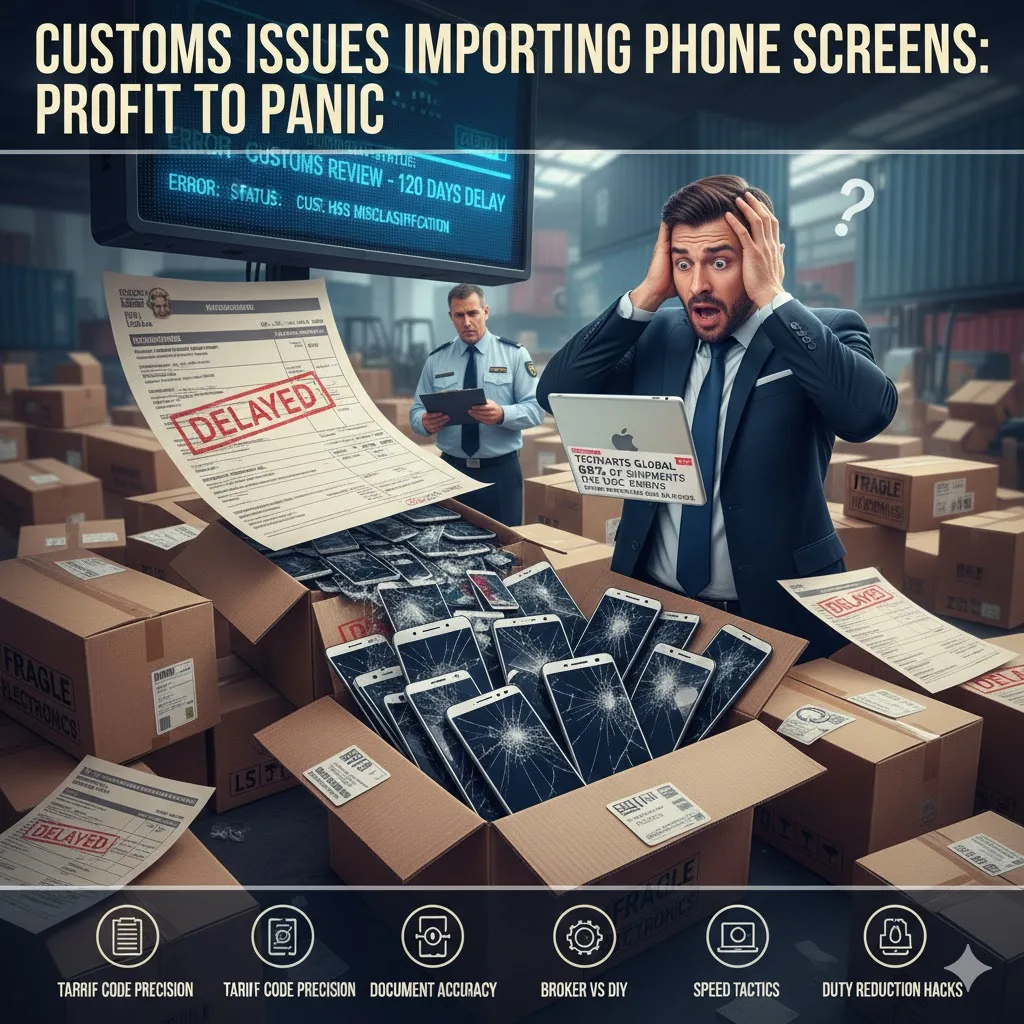
Quick Answers for Conquering Customs Issues Importing Phone Screens
➔ Tariff Code Precision: Misclassifying LCD or OLED screens can lead to costly delays—use accurate HS codes every time.
➔ Document Accuracy: Ensure commercial invoices, packing lists, and certificates of origin are complete and consistent across all paperwork.
➔ Broker vs DIY Decision: A customs broker simplifies the process but costs more; going DIY saves money but demands deep regulatory knowledge.
➔ Speed Tactics: Use EDI portals, insure shipments, package carefully to avoid inspections, and track in real-time for proactive clearace.
➔ Duty Reduction Hacks: Leverage trade agreements, classify components correctly by screen type, and apply for duty drawbacks on returns.
Why Do Customs Hold Phone Screens?
Importing phone screens can feel like walking through a minefield—especially when customs steps in. Here’s why your shipment might hit a snag.
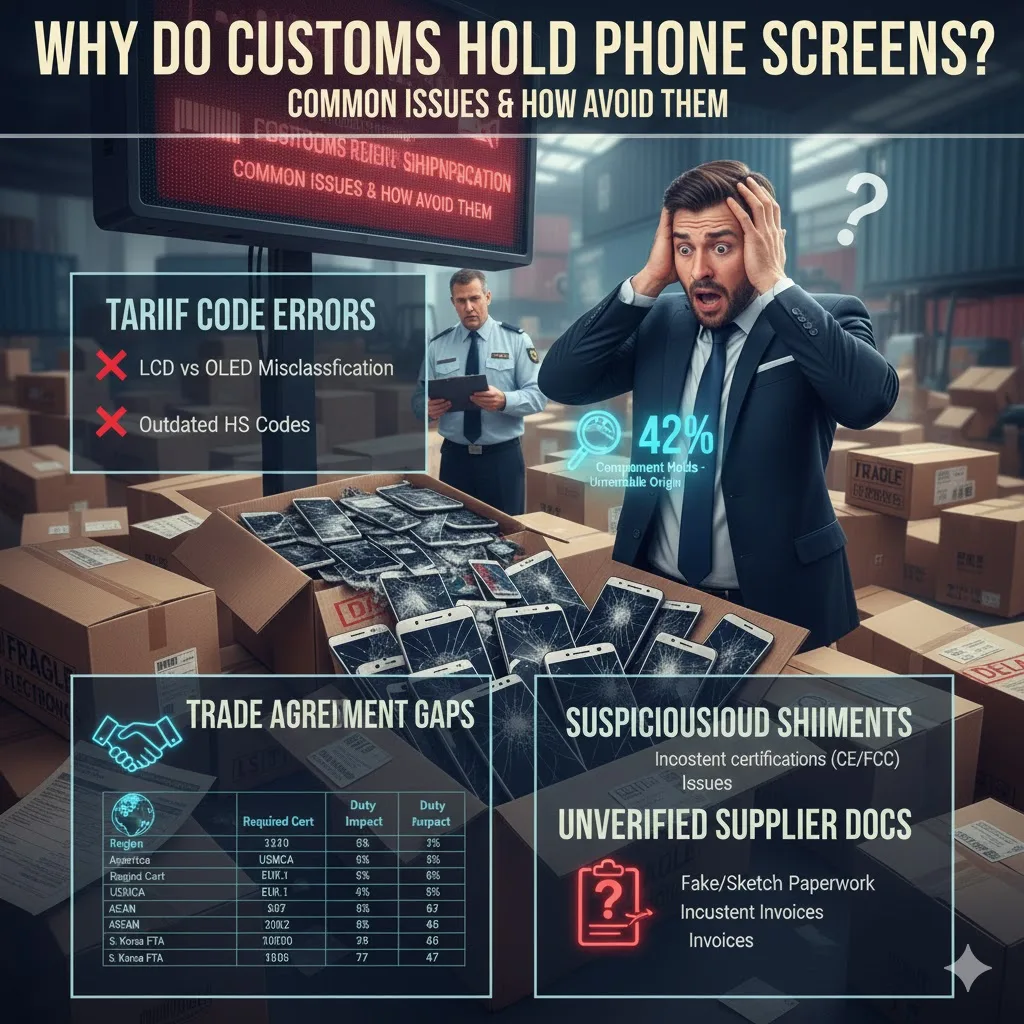
Tariff Code Errors on LCD and OLED Screens
Customs flags shipments fast when tariff codes don’t match the actual product type. Here’s where it often goes sideways:
- LCD screens get misclassified under general electronics instead of display components.
- OLED panels, though newer, still fall under traditional codes if not updated in the system.
- Importers often forget to update HS codes after product changes, which triggers audits.
- Country-specific code updates can differ wildly—what works in Korea might stall your shipment in the EU.
- Customs brokers sometimes rely on outdated templates for documentation.
Avoid these pitfalls by double-checking with a licensed trade compliance consultant before shipping out those high-volume screen orders.
Suspicious Shipments: Quality Control Holds
Sometimes it’s not about paperwork—it’s about what’s inside the box. Customs may pause your phone screen imports due to:
- Inconsistent labeling or mismatched invoice descriptions.
- Packaging that doesn’t meet international safety standards.
- Bulk quantities that raise red flags without proper justification.
- Missing CE or FCC markings, especially for smart-screen modules.
Also, if past shipments had issues, customs keeps an eye out for repeat offenders. Once you’re on their radar, even minor hiccups can trigger full inspections and delays lasting weeks—not days.
Overlooked Trade Agreement Certifications
Missing certificates tied to trade agreements can turn a duty-free dream into an expensive nightmare.
| Region | Required Certificate | Common Omission Reason | Duty Impact (%) |
|---|---|---|---|
| North America | USMCA Certificate | Not updated after NAFTA swap | +8% |
| European Union | EUR.1 Movement Cert | Supplier didn’t provide | +5% |
| ASEAN Countries | Form E | Misfiled during export | +6% |
| South Korea | FTA Statement | Language mismatch | +7% |
Even one missing form could mean thousands lost in unnecessary duties—especially with bulk LCD or OLED shipments meant for resale through platforms like phone-stocks.
Unverified Supplier Documentation Risks
When supplier paperwork looks sketchy—or worse, fake—customs won’t hesitate to put everything on hold.
“According to Q2 2024 data from GlobalTradeWatch, over 42% of electronic component holds stemmed from unverifiable origin documents.”
That means if your supplier doesn’t provide clear manufacturing proof or uses inconsistent invoice formats, your screens could be stuck indefinitely at port while authorities sort things out.
Always triple-check vendor credentials and insist they use standardized commercial invoices with matching pro forma values before you give them the green light to ship anything overseas—even just one batch of AMOLED displays.
Documentation Requirements For Phone Screens Imports
Getting your paperwork right is half the battle when bringing phone screens across borders. Here’s how to avoid hiccups with customs and keep things moving smoothly.
Commercial Invoice Essentials for Electronics
A clean, detailed invoice can save you from a world of headaches at the border. It should always include:
• Product descriptions that match what’s actually being shipped — vague terms like “screen” won’t cut it.
• Precise quantities, broken down by model or variation if possible.
• Accurate declared values, aligning with market rates and supplier costs.
Messy invoices are red flags for customs officers and can lead straight to delays or fines tied to import classification problems.
Packing List Essentials: Fragile Phone Parts
When shipping delicate components like smartphone screens, packing lists need to do more than just list contents:
- Clearly label fragile items using standard handling codes like “Glass – Handle with Care.”
- Include internal box identifiers matching outer carton IDs for traceability.
- Mention weight per unit and total gross weight — often overlooked but vital at customs checkpoints.
If the packing list doesn’t sync with your invoice or shipment contents, expect trouble during inspection, especially when dealing with screen-heavy freight.
Certificate of Origin Compliance Standards
This document isn’t just a formality—it’s your ticket to reduced tariffs under trade deals like USMCA or ASEAN FTAs:
▪️ Must be issued by a recognized chamber or authority from the exporting country.
▪️ Product origin must align with HS code classification—no mismatches allowed.
▪️ Should include exporter signature and date stamp for validation purposes.
Skipping this step could mean paying full duties even if you’re technically eligible for exemptions on imported display components.
Accurate Export Declarations from Suppliers
Multiple short checks can prevent major issues later on:
— Is the export license number correct? A typo here could stall clearance.
— Are all screen models listed using their proper part numbers?
— Does the declared value match what’s on your commercial invoice?
These small things matter big time when customs compares declarations against shipment records during import screening.
Harmonized System Codes for Screen Components
This is where most slip-ups happen—and where duties get miscalculated fast:
Step 1: Identify whether screens are LCD, OLED, or digitizer-only units; each has its own classification nuance under Chapter 85 of HS codes.
Step 2: Cross-check these against WCO updates—codes change more often than you’d think.
Step 3: Confirm alignment between supplier documentation and importer records before filing any entry forms.
Incorrect codes don’t just trigger audits—they can cause overpayment on tariffs tied directly to display tech imports.
Scientific Table – Common HS Codes Used in Display Component Imports
| Component Type | HS Code | Duty Rate (%) | Description Notes |
|---|---|---|---|
| LCD Touch Screen | 8524.91 | Varies | Often misclassified as “TV parts” |
| OLED Display Panel | 8524.99 | Varies | Requires origin verification |
| Digitizer Only Units | 8473.30 | Lower | Usually treated as peripheral accessories |
| Full Assembly Module | 8517.70 | Higher | Includes frame + screen + connectors |
Choosing the wrong code leads straight into duty disputes—a common cause behind customs issues importing phone screens globally.
Multi-item Checklist Before Shipment Hits Customs
Group A – Core Docs You Can’t Skip:
• Commercial Invoice
• Packing List
• Certificate of Origin
Group B – Supplier-Side Accuracy Checks:
• Export license number
• Declared value consistency
• Proper item labeling inside cartons
Group C – Tech-Specific Add-ons:
• Correct HS coding
• Serial numbers per unit batch
• Handling instructions visible outside packaging
Nail these three groups before your cargo leaves port, and you’ll dodge most importing snags related to smartphone display units—even if you’re new to sourcing from Asia or Eastern Europe.
Real-Life Combo Pitfalls & How To Fix Them Fast
Sometimes things go sideways because several small mistakes pile up:
– Your supplier used an outdated HS code… again.
– The invoice says “Display Parts” instead of model-specific detail.
– The certificate of origin got signed but not stamped by the issuing chamber!
Fixing these involves coordination across departments—get procurement talking directly with logistics early on so everyone’s working off synced data files, not guesswork spreadsheets that trigger red flags at customs checkpoints tied to high-value electronics like replacement phone displays.
Customs Issues Importing Phone Screens
If you’re bringing in phone screens from overseas, you’ll likely run into some customs headaches. Here’s how to avoid the worst of it.
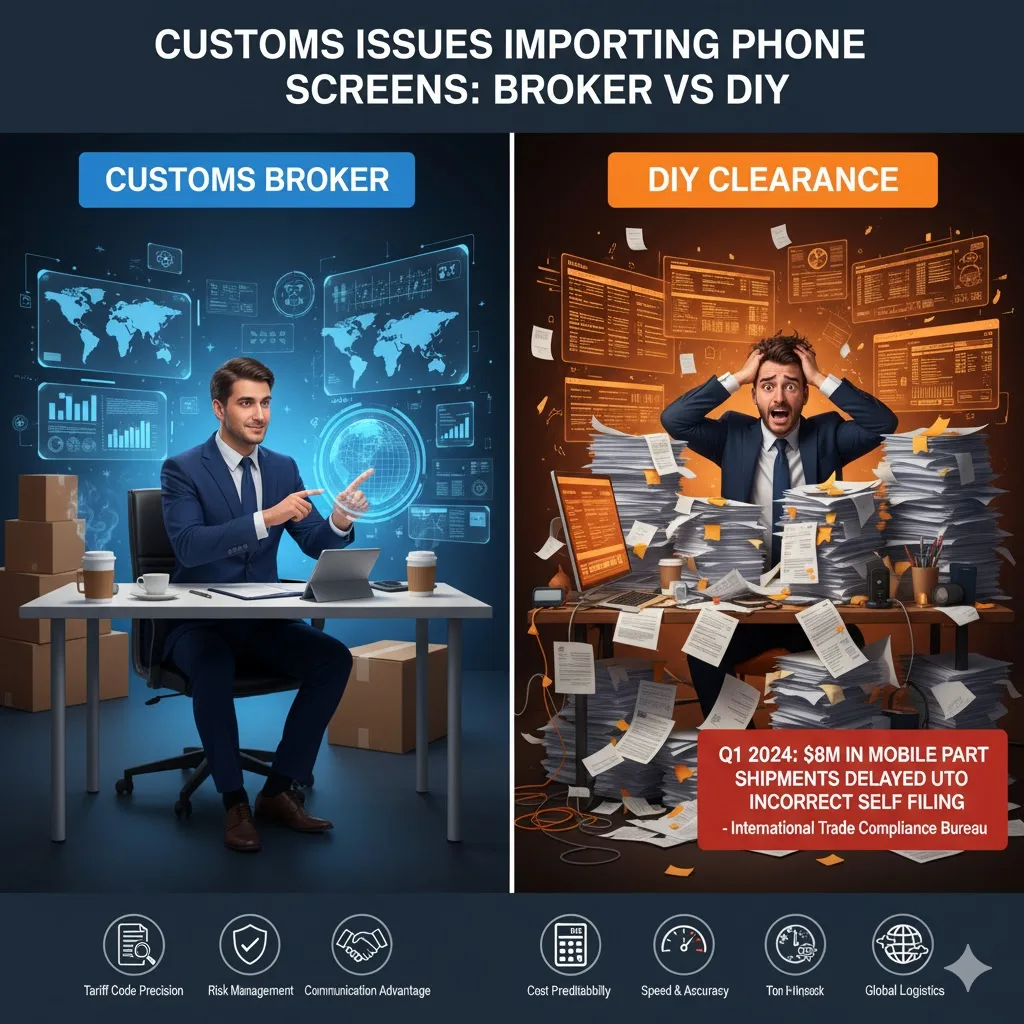
Customs Broker
Hiring a licensed customs broker can feel like paying for peace of mind. These pros deal with sticky import rules so you don’t have to.
- Speed & Accuracy
- They know which documents are needed for different types of phone screen parts, reducing delays.
- Familiarity with Harmonized System codes helps avoid misclassification fines.
- Risk Management
- Brokers keep your shipment compliant with changing international trade laws.
- They monitor tariff updates and alert you when something affects your category.
- Cost Predictability
- Though they charge fees, brokers often prevent costly storage penalties at ports.
- They help estimate duties upfront, so budgeting is less guesswork.
- Communication Advantage
- Brokers act as middlemen between you and agencies like the CBP or FDA if required.
- They’re fluent in customs jargon—something most small importers aren’t.
In short, using a broker means fewer surprises when importing fragile goods like display assemblies or digitizers. For many businesses, it’s worth the cost just to stay out of trouble with port authorities.
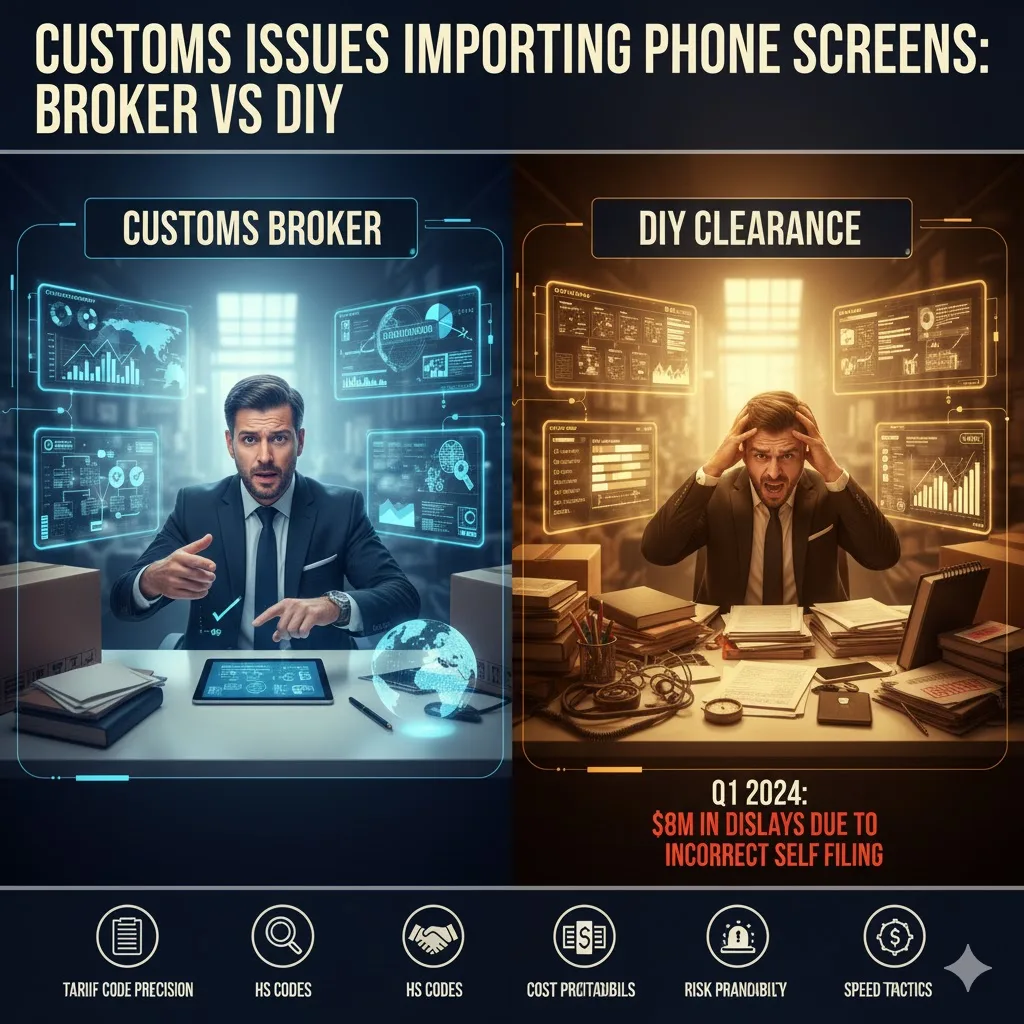
DIY Clearance
Trying to clear your own shipment might sound empowering—until you’re knee-deep in forms and acronyms. Still, some small-scale importers make it work without a licensed broker.
• You’ll need:
- A firm grasp of HS codes specific to LCDs or OLED components
- An understanding of country-specific duty rates and free trade agreements
- Access to ACE (Automated Commercial Environment) for electronic filings
- Start by registering as an importer with U.S. Customs.
- Gather all necessary commercial invoices, packing lists, and certificates.
- Submit entry documents within five days of arrival at port—miss this and things get ugly fast.
💡 “In Q1 of 2024 alone, over $8M in mobile part shipments were delayed due to incorrect self-filing,” says a report from the International Trade Compliance Bureau.
But hey—if your volume is low and you’ve got time to learn the ropes? It’s doable. Just don’t expect it to be plug-and-play; there’s real legwork involved when shipping high-fragility items like replacement touchscreens or glass panels across borders without professional help.
How To Expedite Customs Clearance For Phone Screens?
Speeding up customs clearance for phone screen shipments isn’t just about luck—it’s about smart prep and knowing what slows things down.
4 Steps to Streamline Clearance with EDI Portals
• Digitize your shipping documents early using a reliable EDI system.
• Coordinate with your freight forwarder to ensure all data is pre-submitted before arrival.
• Use consistent product codes, especially for HS classification, to avoid red flags.
• Double-check that your invoice values match declared customs values—discrepancies cause delays.
Even if you’re importing just a few hundred phone screens, skipping EDI can turn a 24-hour clearance into a week-long mess.
Insure Your Shipment: International Insurance Options
- Basic Carrier Liability – Often free but covers minimal value; not ideal for fragile goods like phone screens.
- All-Risk Cargo Insurance – Covers theft, damage, or loss during transit; best for high-value electronics imports.
- Named Perils Coverage – Cheaper than all-risk but only protects against listed events like fire or collision.
Global Trade Review (2024) reports that insured shipments clear customs 18% faster on average due to fewer disputes over damaged goods.
Protective Packaging to Reduce Inspection Delays
☑ Use anti-static bubble wrap and foam inserts tailored for each unit of the screen assembly.
☑ Choose tamper-evident outer cartons labeled with product type and HS code externally visible.
☑ Reinforce corners with edge protectors—customs often inspects packages showing wear or deformation.
You’d be surprised how often weak packaging triggers inspections—not because something’s wrong, but because it “looks suspicious.”
Real-Time Tracking for Customs Bottleneck Alerts
Real-time tracking tools aren’t just about watching your shipment crawl across the ocean—they help you act fast when things stall at borders.
→ Set up alerts through your carrier’s portal tied directly to customs scans and hold notices.
→ If you see “Pending Documentation” pop up? Call your broker immediately.
→ Use tracking data trends from previous shipments to identify repeat bottlenecks at specific ports or terminals.
With so many moving parts in international trade, being able to respond within minutes instead of hours can mean everything when dealing with import hiccups around phone screens.
Customs Issues Importing Phone Screens
Getting phone screens across borders? It’s not just paperwork—it’s a minefield of tariffs, duties, and classification nightmares.
Leveraging Free Trade Agreements to Cut Duties
- Free Trade Agreements, like USMCA or ASEAN-China FTA, can slash your import costs if your supplier’s country qualifies.
- But don’t assume you’re covered—check:
- Origin rules
- Certificate validity
- Product-specific inclusion
- A big miss? Not matching the screen specs with the agreement’s product codes.
Pro tip: Work with a trade compliance expert who understands how these deals apply to electronic displays. One wrong assumption and you’re stuck paying full duty on every shipment.
Correct Classification: LCD vs OLED Tariff Codes
| Screen Type | HS Code Example | Typical Duty Rate | Common Misclassification Issue |
|---|---|---|---|
| LCD | 8528.52 | ~5% | Mistaken for generic display units |
| OLED | 8529.90 | ~0%-2% | Misfiled under LED lighting components |
It might look like just a screen, but customs sees it as a puzzle piece in a bigger tariff game. Choosing the wrong code could mean overpaying by hundreds per shipment—or worse, getting flagged for misdeclaration.
Always double-check with customs brokers before filing—especially when importing high-end OLEDs or refurbished LCD modules.
Utilizing Duty Drawback for Returning Defective Screens
• Got defective screens returning from customers? That doesn’t mean you eat the cost.
• Under a duty drawback program, you can reclaim up to 99% of paid duties and taxes.
• But here’s the catch:
• You need airtight records.
• The return process must be documented within strict timelines.
• Only certain ports handle drawback claims efficiently.
If you’re consistently importing repairable screens or dealing with warranty returns, setting up this system is a no-brainer. Just don’t expect it to work without some upfront admin hustle—and possibly help from someone who knows their way around CBP Form 7553.
FAQs about Customs Issues Importing Phone Screens
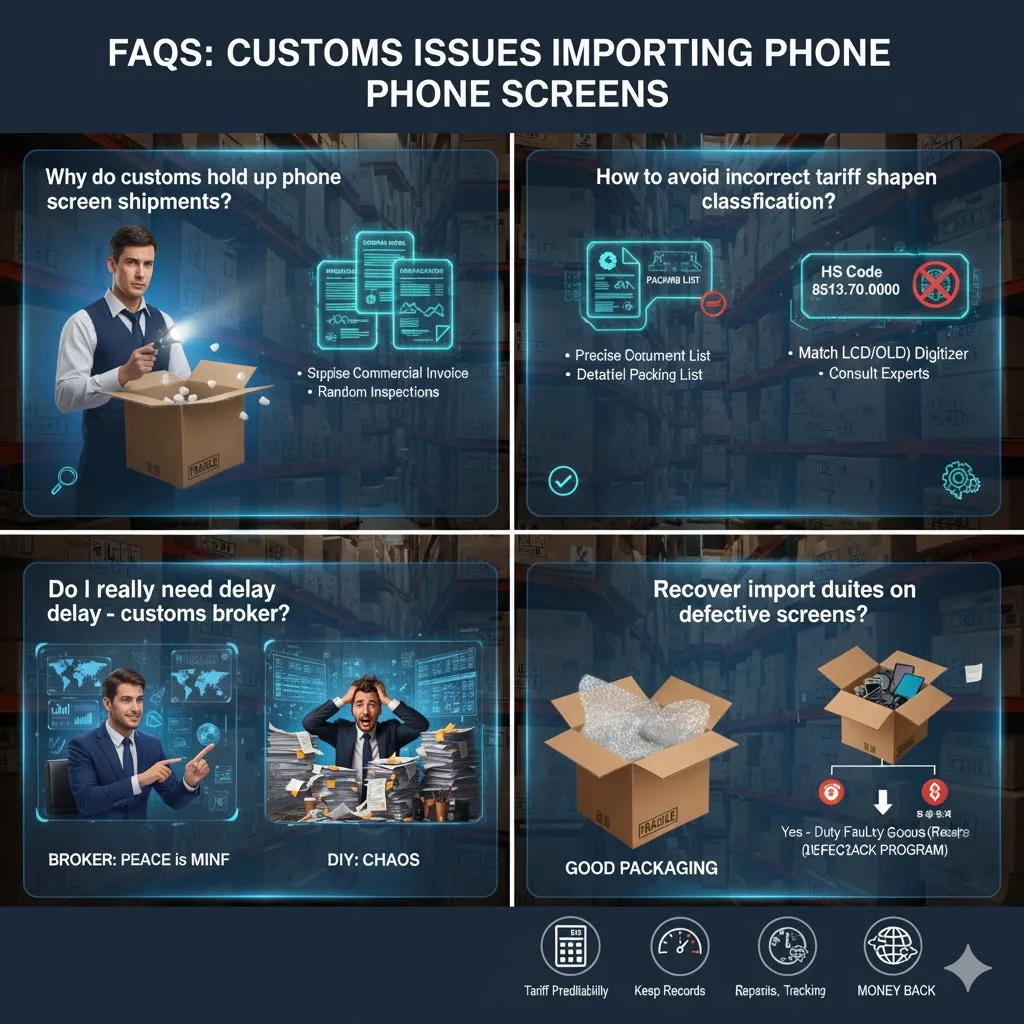
Why do customs hold up phone screen shipments even when papers seem fine?
Sometimes everything looks perfect on paper—but the shipment still gets flagged. This can happen if a supplier has a history of inconsistencies, or if customs officers spot packaging damage that hints at possible fraud or mislabeling. Even random inspections tied to certain HS codes can cause delays. It’s not always logical; it’s often about patterns and red flags you don’t see coming.
What documents are absolutely essential for smooth clearance?
Customs agents aren’t just checking boxes—they’re looking for consistency across every detail. These documents usually make or break your timeline:
- A precise commercial invoice with exact product descriptions and declared value
- A packing list showing quantities and how items are packaged (especially critical for fragile screens)
- Certificate of Origin—vital if you’re relying on trade agreements to reduce duties
If one piece is off, expect questions…or worse, an inspection.
How do I avoid problems caused by incorrect tariff classification?
Using the wrong Harmonized System (HS) code might seem like a small error—but it can lead to overpaying duties or having your goods seized until reclassified. Make sure each type of screen—LCD, OLED, digitizer—is matched correctly from the start. If in doubt, consult someone who knows exactly how these codes work in practice—not just theory.
Do I really need a customs broker when importing phone screens in bulk?You could go solo—but only if you’re ready to juggle paperwork under pressure while navigating shifting regulations mid-shipment. Brokers know what forms trigger holds and which phrases raise eyebrows at ports:
- They help classify parts accurately so duty rates match expectations
- They catch mismatches between invoices and declarations before customs does
- And they’ve seen enough horror stories to steer clear of common traps
It’s less about needing permission—and more about avoiding chaos.
Can poor packaging actually delay my shipment at customs?Absolutely—and it’s more common than you’d think. Fragile components like touchscreen digitizers must be packed tightly with protective layers inside sturdy cartons. When boxes arrive crushed or leaking foam peanuts all over inspection tables, agents get suspicious fast—it screams carelessness…or worse, concealment.
A well-packed box tells officials you take compliance seriously—even before they open it.
Is there any way to recover import duties on defective screens sent back overseas?Yes—but timing is everything here. If you return faulty units abroad within specific timeframes and keep airtight records—including proof of export—you may qualify for duty drawback programs offered by many countries’ customs agencies.
Think receipts + tracking numbers + original payment docs = money back in your pocket instead of lost forever in bureaucracy limbo.








Recent Comments