


Two numbers decide whether a cleaning routine is safe, and neither of them is about the glass.
The first is 10 to 20 nanometres: the full thickness of the anti-fingerprint layer sitting on top of the display, the oleophobic film the industry deposits in a vacuum chamber and bonds to the glass. A sheet of A4 paper is about 100,000 nanometres thick. The second number is 70 percent, the alcohol concentration both major phone makers stop at.
Get either one wrong and nothing dramatic happens. The glass survives, the picture is fine, and the screen slowly starts to grab at your fingertip and hold smudges where it used to shed them. There is no repair for that short of a new panel.
Specification source: DisplayModule’s durability notes put the coating at 10–20 nm of PVD fluorosilane against roughly 100,000 nm for a sheet of A4; checked 2 November 2026.
That matters more on a repair bench than it does in a kitchen. A phone owner loses the “new phone feel” on one device. A shop that cleans 200 assemblies a week with the wrong cloth, the wrong solvent, or a spray bottle pointed at the bezel loses the coating on 200 of them, and then sells them.
The glass is the one layer you cannot really hurt
A display assembly is a stack, and every layer responds to a different thing. Cleaning advice that treats “the screen” as one surface is advice that cannot tell you which of these you are about to damage.
| Layer | What it is | What actually damages it |
|---|---|---|
| Cover glass | Tempered aluminosilicate, the part your finger touches | Grit under pressure, sand in a pocket, a drop on a corner |
| Anti-fingerprint coating | Fluorosilane, 10–20 nm. The oleophobic layer | Abrasion, high-concentration alcohol, anything formulated to strip grease |
| OCA | The optically clear adhesive bonding glass to panel | Heat, solvent creeping in from the edge |
| Polarizer | Iodine-doped PVA between two TAC films | Water at a bare cut edge |
| Touch sensor and cell | ITO traces on glass, LCD or OLED beneath | Pressure, liquid at the FPC connector |
Read it twice and the usual advice reorders itself. Glass is hard; you will not scratch it with a cloth. The layer you can destroy with a routine is the thin one on top, and the layer that fails weeks later is the one you cannot see at all.
Reversibility is the useful test here. A smudge wipes off and comes back tomorrow. A worn coating does not return, and neither does a polarizer edge that has taken water.
70 percent is a ceiling, not a starting point
Apple permits 70% isopropyl alcohol wipes, 75% ethanol wipes and Clorox disinfecting wipes on the exterior of an iPhone, with three conditions attached: check the expiry date, keep liquid out of every opening, and do not submerge the device. Bleach and hydrogen peroxide are out.
cURL Too many subrequests by single Worker invocation. To configure this limit, refer to https://developers.cloudflare.com/workers/wrangler/configuration/#limits Apple’s iPhone cleaning guidance also states that compressed air should not be used at all, and that after disinfecting you wipe the surface with a soft, slightly damp, lint-free cloth; checked 2 November 2026.
Samsung’s version is broader in what it allows and narrower in where it applies: distilled water, an alcohol-based product above 70% ethanol or isopropyl, or hypochlorous acid at 50–80 ppm, applied with a dampened cloth corner, on glass, ceramic and metal only. Not on leather, rubber or plastic trim.
cURL Too many subrequests by single Worker invocation. To configure this limit, refer to https://developers.cloudflare.com/workers/wrangler/configuration/#limits Samsung’s Galaxy cleaning guidance repeats the same two prohibitions, compressed air and bleach, and adds an explicit warning against excessive wiping; checked 2 November 2026.
So 70 percent is the number both makers name, and neither of them points upward from there. What shops buy instead is 91% or 99% isopropyl, because it sounds like the same product with less water in it. It is not. The higher concentration flashes off fast enough that you spend more of the wipe pushing oil around than lifting it, and you do that pushing with a stronger solvent than the film’s designers assumed. You pay more per litre for a worse result.
Two more things that end up on screens: hand sanitiser and household glass cleaner. Sanitiser is alcohol plus glycerin and fragrance, and glycerin is a humectant, which is a polite way of saying it stays on the glass and pulls dust to it. Glass cleaner is formulated to strip grease from a hard uncoated surface, which is a fair description of what your coating is.
The edge fails first, and it takes about three weeks to show
cURL Too many subrequests by single Worker invocation. To configure this limit, refer to https://developers.cloudflare.com/workers/wrangler/configuration/#limits.
cURL Too many subrequests by single Worker invocation. To configure this limit, refer to https://developers.cloudflare.com/workers/wrangler/configuration/#limits.
cURL Too many subrequests by single Worker invocation. To configure this limit, refer to https://developers.cloudflare.com/workers/wrangler/configuration/#limits.
Data source: cURL Too many subrequests by single Worker invocation. To configure this limit, refer to https://developers.cloudflare.com/workers/wrangler/configuration/#limits.
cURL Too many subrequests by single Worker invocation. To configure this limit, refer to https://developers.cloudflare.com/workers/wrangler/configuration/#limits.
cURL Too many subrequests by single Worker invocation. To configure this limit, refer to https://developers.cloudflare.com/workers/wrangler/configuration/#limits cURL Too many subrequests by single Worker invocation. To configure this limit, refer to https://developers.cloudflare.com/workers/wrangler/configuration/#limits cURL Too many subrequests by single Worker invocation. To configure this limit, refer to https://developers.cloudflare.com/workers/wrangler/configuration/#limits.
cURL Too many subrequests by single Worker invocation. To configure this limit, refer to https://developers.cloudflare.com/workers/wrangler/configuration/#limits
cURL Too many subrequests by single Worker invocation. To configure this limit, refer to https://developers.cloudflare.com/workers/wrangler/configuration/#limits.
cURL Too many subrequests by single Worker invocation. To configure this limit, refer to https://developers.cloudflare.com/workers/wrangler/configuration/#limits.
- cURL Too many subrequests by single Worker invocation. To configure this limit, refer to https://developers.cloudflare.com/workers/wrangler/configuration/#limits.
- cURL Too many subrequests by single Worker invocation. To configure this limit, refer to https://developers.cloudflare.com/workers/wrangler/configuration/#limits.
- cURL Too many subrequests by single Worker invocation. To configure this limit, refer to https://developers.cloudflare.com/workers/wrangler/configuration/#limits.
- cURL Too many subrequests by single Worker invocation. To configure this limit, refer to https://developers.cloudflare.com/workers/wrangler/configuration/#limits.
cURL Too many subrequests by single Worker invocation. To configure this limit, refer to https://developers.cloudflare.com/workers/wrangler/configuration/#limits.
cURL Too many subrequests by single Worker invocation. To configure this limit, refer to https://developers.cloudflare.com/workers/wrangler/configuration/#limits cURL Too many subrequests by single Worker invocation. To configure this limit, refer to https://developers.cloudflare.com/workers/wrangler/configuration/#limits cURL Too many subrequests by single Worker invocation. To configure this limit, refer to https://developers.cloudflare.com/workers/wrangler/configuration/#limits.
cURL Too many subrequests by single Worker invocation. To configure this limit, refer to https://developers.cloudflare.com/workers/wrangler/configuration/#limits
Six steps, about a minute and three quarters, and none of them require a product with a screen on the label.
- Power the device off and unplug it. On a bare assembly, disconnect nothing you do not have to; just keep the FPC away from the wet end of the cloth.
- Dry pass from top to bottom in one direction, light pressure. If the cloth picks up visible grit, change it before you go near liquid.
- Damp pass with a 70% isopropyl wipe or a cloth corner wetted with distilled water. Damp, not wet: if you can see liquid sitting on the glass, there is too much. Work from the centre outward and stop short of the bezel.
- Buff dry with the dry half of the cloth or a second cloth. Single direction, no circles, no pressure.
- Earpiece mesh, speaker slots and camera ring: dry soft brush only. Both makers rule out compressed air, and a pin in a mesh is how a mesh becomes a hole.
- Ports: hold the device port-down and tap the lint out, then run a wooden toothpick along the wall of the connector. Never into the contacts, never with air, never with a metal tool.
| Step | Seconds per unit | What skipping it causes |
|---|---|---|
| Dry pass | 20 | Grit dragged across the coating under liquid |
| Damp pass | 35 | Oil smeared into the micro-texture, then baked in |
| Buff | 15 | Streaks that read as a dirty screen and come back as a complaint |
| Edges and mesh | 20 | Dust ring at the bezel, the most photographed defect on a return |
| Ports | 15 | Lint plug, intermittent charging, a fault that is not a fault |
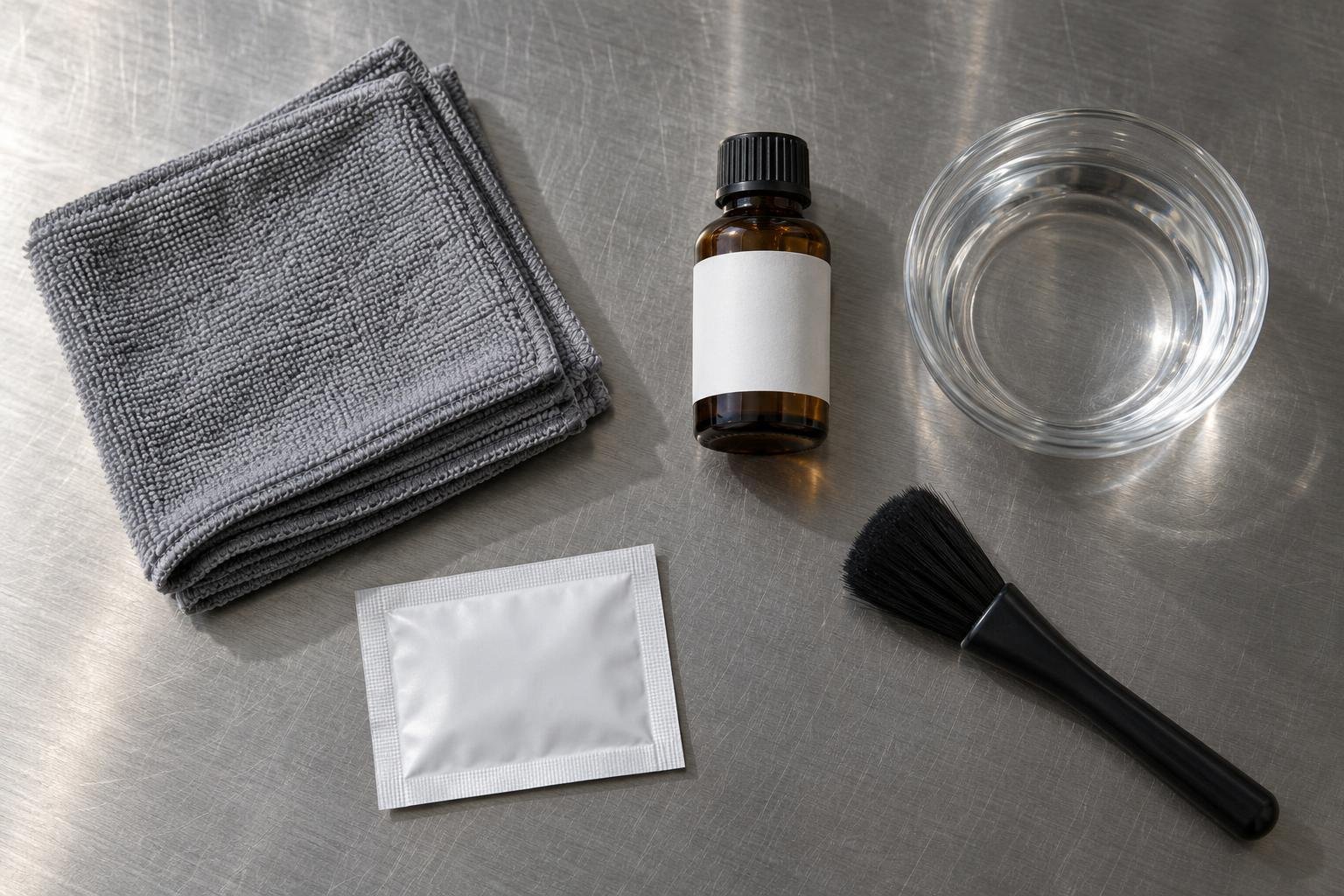
Figure basis: the per-step timings are a bench estimate for a 6.1-inch assembly, not a time-and-motion study. Substitute your own numbers; the arithmetic in the next section is the part that matters.
At 200 units a day the arithmetic changes
A single wipe with a cloth that has already seen service takes about 60 seconds: one pass, no dry pass, no buff. The six-step version takes 105.
At 200 units a day, that is 3 hours 20 minutes against 5 hours 50 minutes. Two and a half hours a shift, for the difference between cleaning a screen and wearing one out.
Put it against the other side of the ledger and the choice stops being close. Consumables run to cents per unit: a 70% wipe, a share of a cloth, a little distilled water. One assembly scrapped because its coating went cloudy, or because water found the polarizer edge, costs more than a month of wipes, and it costs it in a unit you had already paid freight on. The number worth arguing about with a bench lead is the 45 seconds, not the alcohol.
Where the volume actually bites is batching. One person doing dry passes on twenty units, then damp passes on the same twenty, then buffing, is faster per unit than one person doing all six steps on one unit at a time, because the cloth never has to be swapped between roles and the setup is paid once. It also makes the dry pass impossible to skip, which is where most of the coating damage happens.
What cleaning cannot fix
A worn coating is not dirty, and no product restores it. The way to find out where a unit stands is a water bead: a drop of water on the middle of the glass either sits up in a dome that a tilt will roll off, or it spreads out flat and stays.
New coating measures above 115°. Between 100° and 90° droplets start to flatten and fingerprints get harder to wipe. Below 75° it is finished, and the screen will feel sticky to the person who buys it. Those thresholds come from coating suppliers, not from the phone makers, so treat them as the shape of the curve rather than a spec you can hold anyone to.
Specification source: the contact-angle bands and the abrasion figures (2,000–3,000 steel-wool cycles at 1 kg for entry-level coated glass, above 10,000 for flagship) are from DisplayModule’s coating wear notes; checked 2 November 2026.
Run that test on incoming stock. It takes three seconds, it needs no instrument, and it separates two assemblies that look identical under a light. Do it in the middle of the panel, dry it immediately, and keep the water away from the edge. An assembly that wets out flat will feel wrong in a customer’s hand within a month, and it will feel like your fault.
Aftermarket re-coating liquids exist and they do change the feel for a while. They sit on the surface rather than bonding into it, they wear faster than a factory PVD film, and nothing about them gets you back to a 10,000-cycle number. If you re-coat a used assembly, grade it accordingly: a re-coated unit is a B-grade unit with a nicer first impression.
Three things that look like cleaning problems and are not: a stain under the glass is a lamination defect and belongs in an RMA, not on a bench; an edge bubble is delamination; and a scratch you can feel with a fingernail is through the coating and into the glass. Cleaning is for oil and dust. Everything else is a grading question.
Five ways a good screen dies on the bench
| What happens | cURL Too many subrequests by single Worker invocation. To configure this limit, refer to https://developers.cloudflare.com/workers/wrangler/configuration/#limits | cURL Too many subrequests by single Worker invocation. To configure this limit, refer to https://developers.cloudflare.com/workers/wrangler/configuration/#limits | cURL Too many subrequests by single Worker invocation. To configure this limit, refer to https://developers.cloudflare.com/workers/wrangler/configuration/#limits |
|---|---|---|---|
| cURL Too many subrequests by single Worker invocation. To configure this limit, refer to https://developers.cloudflare.com/workers/wrangler/configuration/#limits | cURL Too many subrequests by single Worker invocation. To configure this limit, refer to https://developers.cloudflare.com/workers/wrangler/configuration/#limits | cURL Too many subrequests by single Worker invocation. To configure this limit, refer to https://developers.cloudflare.com/workers/wrangler/configuration/#limits | cURL Too many subrequests by single Worker invocation. To configure this limit, refer to https://developers.cloudflare.com/workers/wrangler/configuration/#limits |
| cURL Too many subrequests by single Worker invocation. To configure this limit, refer to https://developers.cloudflare.com/workers/wrangler/configuration/#limits | cURL Too many subrequests by single Worker invocation. To configure this limit, refer to https://developers.cloudflare.com/workers/wrangler/configuration/#limits | cURL Too many subrequests by single Worker invocation. To configure this limit, refer to https://developers.cloudflare.com/workers/wrangler/configuration/#limits | cURL Too many subrequests by single Worker invocation. To configure this limit, refer to https://developers.cloudflare.com/workers/wrangler/configuration/#limits |
| cURL Too many subrequests by single Worker invocation. To configure this limit, refer to https://developers.cloudflare.com/workers/wrangler/configuration/#limits | cURL Too many subrequests by single Worker invocation. To configure this limit, refer to https://developers.cloudflare.com/workers/wrangler/configuration/#limits | cURL Too many subrequests by single Worker invocation. To configure this limit, refer to https://developers.cloudflare.com/workers/wrangler/configuration/#limits | cURL Too many subrequests by single Worker invocation. To configure this limit, refer to https://developers.cloudflare.com/workers/wrangler/configuration/#limits |
| cURL Too many subrequests by single Worker invocation. To configure this limit, refer to https://developers.cloudflare.com/workers/wrangler/configuration/#limits | cURL Too many subrequests by single Worker invocation. To configure this limit, refer to https://developers.cloudflare.com/workers/wrangler/configuration/#limits | cURL Too many subrequests by single Worker invocation. To configure this limit, refer to https://developers.cloudflare.com/workers/wrangler/configuration/#limits | cURL Too many subrequests by single Worker invocation. To configure this limit, refer to https://developers.cloudflare.com/workers/wrangler/configuration/#limits |
| cURL Too many subrequests by single Worker invocation. To configure this limit, refer to https://developers.cloudflare.com/workers/wrangler/configuration/#limits | cURL Too many subrequests by single Worker invocation. To configure this limit, refer to https://developers.cloudflare.com/workers/wrangler/configuration/#limits | cURL Too many subrequests by single Worker invocation. To configure this limit, refer to https://developers.cloudflare.com/workers/wrangler/configuration/#limits | Dry install, in the same clean pass |
When this advice does not apply
An IP68-rated phone that has been in seawater can be rinsed under a tap, and some makers have said so in writing for specific models. That guidance assumes a sealed, assembled device with gaskets in place. Do not carry it across to a bare assembly with an exposed polarizer edge, which is a different object with a different failure mode.
Etched and nano-textured glass is another exception. Apple’s instruction for those finishes is a soft, slightly damp lint-free cloth, plus an explicit warning not to try to remove the texture layer at all. A matte finish that has been polished back to a shine has been ruined, not cleaned.
Ultrasonic cleaning is the one people ask about and should not attempt. A tank is the right tool for a frame, a board or a set of small parts, and the wrong tool for a laminated stack: cavitation works on every interface in the assembly, including the ones holding the polarizer to the cell, and the liquid reaches the cut edge by definition. If a unit is dirty enough that a wipe will not do it, it is a grading problem, not a cleaning problem.
Leather, rubber and plastic trim are excluded by Samsung’s guidance even when the glass next to them is in scope. Alcohol on a plastic bezel is how a shiny bezel becomes a matte one.
And a screen protector with its own oleophobic layer is a consumable. When it stops beading water, replace it. Trying to restore the coating on a protector is a worse use of a bench minute than anything else in this article.
Questions that come up on the bench
Can I use 70% alcohol wipes every day?
For disinfection on a sealed device, both makers allow it. As a daily cleaning habit on the same panel, no. The guidance is written for occasional disinfection of a surface, not for routine removal of fingerprints, and the coating does not distinguish between the two. Dry cloth for fingerprints, wipe for grease, alcohol for germs.
Is hand sanitiser safe if it is only alcohol and water?
It is rarely only alcohol and water. Glycerin, aloe, fragrance and thickeners all leave something behind, and the glycerin keeps pulling moisture and dust to the glass. If sanitiser is all you have, use it on the back and the frame, not the display.
Does toothpaste really remove scratches?
It removes the top of the coating, which is why the scratch looks less visible afterwards. You have traded a scratch for a panel that will smudge for the rest of its life. On an assembly you intend to sell, that is a downgrade, not a repair.
Why does my screen feel sticky right after cleaning?
Either there is residue on it, which means the buff step was skipped or the cloth was loaded with softener, or the coating is already gone and you are feeling bare glass. The water bead test tells you which within seconds.
Can I use tap water?
Distilled is what Samsung specifies, and it is the right call where hardness is high. Tap water leaves mineral spotting as it dries, and spotting on a coated surface is a smear you cannot buff out without wetting it again.
Should the phone be off while I clean it?
Both makers say power down first. On a sealed phone it is about avoiding phantom touches and stray input. On a bare assembly it is about the FPC: a connector that is live while you are working a damp cloth near it is a connector you can short, and the symptom that follows is usually intermittent touch rather than a dead panel.
Cleaning is the second half of intake. The first half happens in the two seconds after the bag comes off, and that one is covered in anti-static packaging for wholesale phone screens. If you are rewriting the receiving process rather than one bench step, the other page to read alongside it is how to test a wholesale phone screen before buying in bulk.
Sources
| Document | Issued by | 一致的读数保持您的 |
|---|---|---|
| Cleaning your iPhone | Apple Support | HT 108765 |
| Cleaning your Apple products | Apple Support | HT 103258 |
| How to clean my Galaxy phone | Samsung Support UK | Mobile devices cleaning guide |
| How to clean your Galaxy device | Samsung Support UK | Glass, ceramic and metal surfaces |
| OLED screen durability: coating wear and contact angle | DisplayModule | Knowledge base |
| Failure mechanism of iodine-doped PVA polarizer under high temperature and high humidity (in-text attribution; publisher blocks automated access) | ACS Applied Polymer Materials 7(22) | DOI 10.1021/acsapm.5c02936 |
cURL Too many subrequests by single Worker invocation. To configure this limit, refer to https://developers.cloudflare.com/workers/wrangler/configuration/#limits.






最新评论