

In the world of wholesale stakes, choosing the right OLED Screen Replacement is a high-wire act—profit or repair nightmare, you decide.
Wholesale OLED Screen Replacement for the Galaxy S25 isn’t just a parts order—it’s a margin gamble. One batch keeps customers grinning; the next has your techs muttering under their breath. OEM panels cost more, sure—but callbacks, color drift, and ghost touch issues cost even more. In a tight repair market, every screen is a bet on your reputation.
IBISWorld notes steady growth in U.S. smartphone repair demand through 2025—competition is heating up.
So here’s the real question: pay upfront for factory precision, or pocket the spread and risk the comeback? Let’s get into the specs that decide.
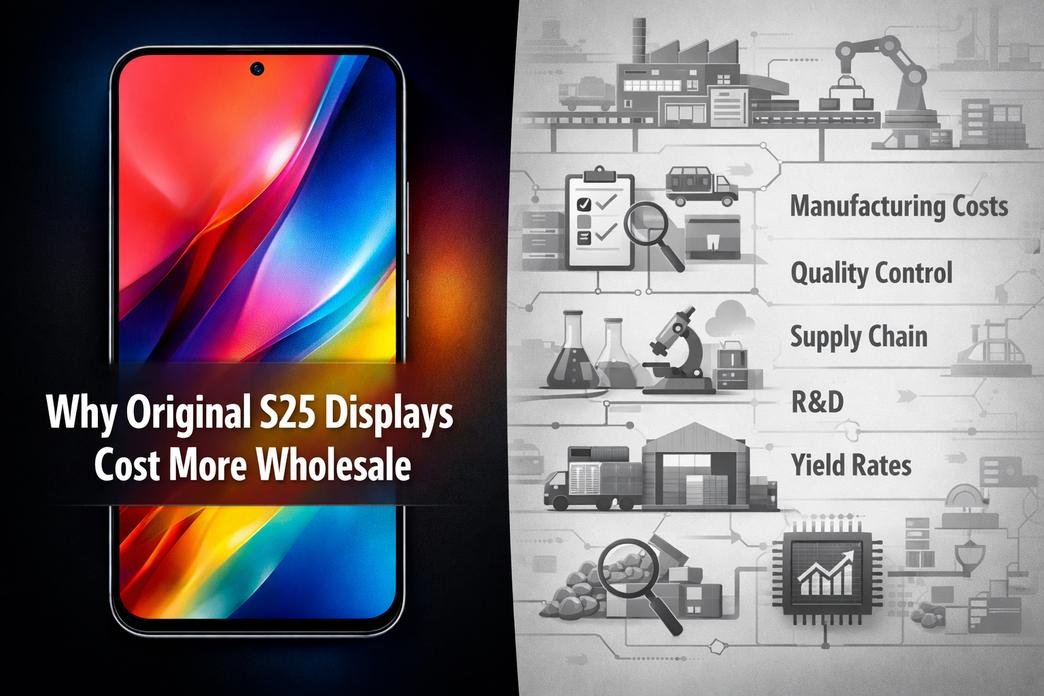
Why Original S25 Displays Cost More Wholesale
When people search for OLED Screen Replacement, or even split it into OLED screen and screen replacement, the price gap can feel wild. An original panel costs more for a reason. From display technology to supplier contracts, every layer adds weight to the final bill.
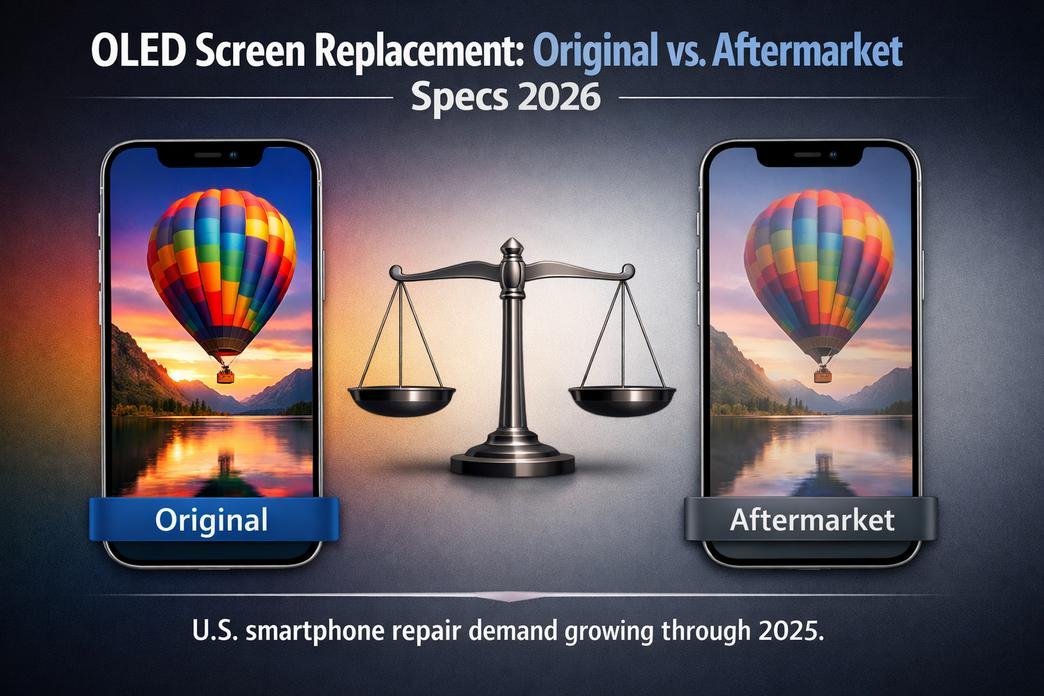
Premium aftermarket vs. original specification gap
When comparing OLED Screen Replacement options, the gap shows up in layers:
- Core display technology differences
- a. Factory tuning
- i. Precise color accuracy calibration
- ii. Stable brightness levels under stress
- b. Integrated controller pairing
- i. Certified IC matching
- ii. Consistent refresh rate
- a. Factory tuning
- Performance tolerance
- a. Tight resolution standards
- b. Tested touch sensitivity response curves
- Durability controls
- a. Long-cycle burn testing
- b. Structural durability validation
Aftermarket OLED screen replacement parts may look close on paper, yet small shifts in tolerance stack up. For repair shops using screen stocks, fewer comebacks mean fewer headaches.
Factory-grade AMOLED sourcing expenses
Original OLED Screen Replacement panels cost more because of real production pressure:
- Higher manufacturing costs tied to flexible substrates
- Strict material sourcing contracts
- Intensive quality control checkpoints
Add in:
- Lower acceptable yield rates
- Ongoing research and development
- Complex supply chain management
- Heavy energy consumption
Counterpoint Research noted in a 2025 display outlook that flagship OLED production remains constrained by yield optimization and advanced material costs, keeping wholesale pricing elevated.
That’s why a true OLED screen from factory lines won’t match generic screen replacement pricing. screen stocks focuses on panels aligned with original OLED standards, not watered-down copies.
Supplier relationship and warranty terms in OEM procurement
Wholesale pricing also reflects business structure:
- Contract negotiation layers
- a. Volume lock-ins
- b. Intellectual property protection
- Risk coverage
- a. Defined return policies
- b. Formal quality assurance agreements
- Operational backing
- a. Dedicated technical support
- b. Managed lead times
- c. Enforced volume commitments
An OLED Screen Replacement sourced through OEM channels carries warranty weight and accountability. That stability costs more upfront, yet for repair pros buying from screen stocks, it often saves money over time.
Wholesale OLED Screen Replacement Cost Breakdown
Wholesale pricing for OLED Screen Replacement orders isn’t just about the sticker price. From panel tuning to freight paperwork, every detail shapes the final cost of OLED screen replacement units in bulk.
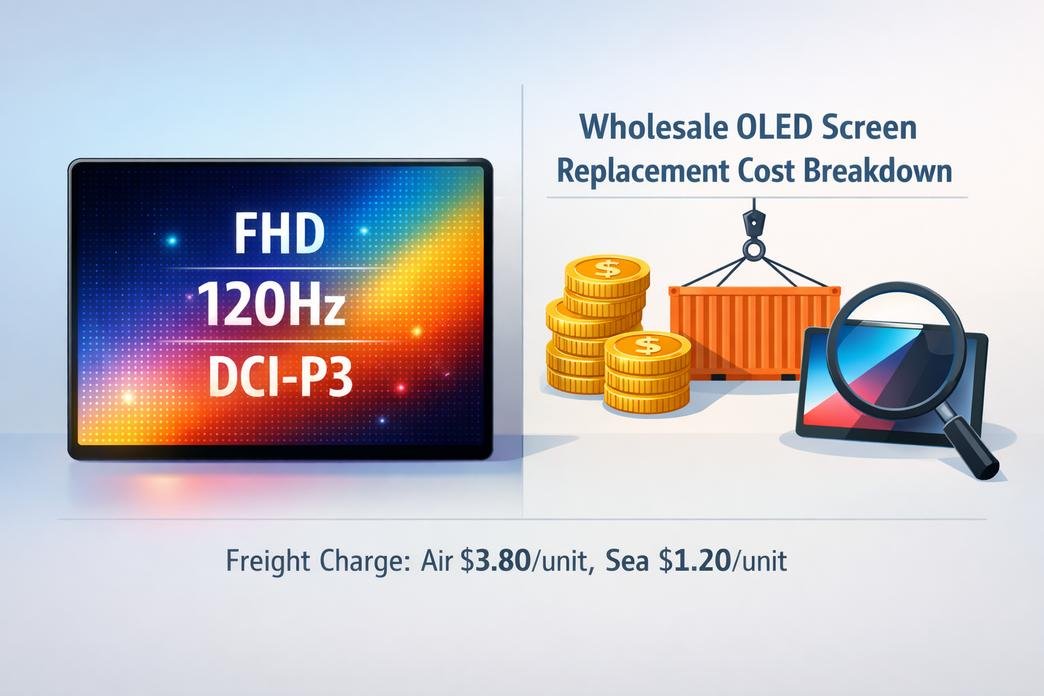
Display panel unit price and color gamut variance
When sourcing an OLED Screen Replacement, panel cost starts with the OLED panel itself, but pricing splits into layered factors:
- Core display specifications
- display resolution: FHD, 2K, or higher directly shifts base pricing
- pixel density: tighter layouts raise material precision costs
- refresh rate: 60Hz panels differ sharply from 120Hz inventory
- Visual performance calibration
- color accuracy tuning for OEM-grade standards
- brightness levels measured in nits for outdoor visibility
- contrast ratio adjustments impacting black depth
- Color gamut variance
- sRGB standard batches
- DCI-P3 high gamut lines
- Custom calibration runs for premium OLED screen replacement projects
Higher gamut calibration increases testing hours and sorting labor. That’s why screen stocks aligns supply tiers clearly, so buyers know exactly what level of OLED Screen Replacement they’re locking in.
Touchscreen assembly integration costs
An OLED screen replacement isn’t just glass and pixels. Integration adds real expense:
- touch sensor layering
- digitizer layer bonding
- flex cable positioning
Assembly flow often looks like this:
- Adhesive prep and adhesive application
- Precision alignment
- Electrical linking
- Functional testing
Behind that, hidden factors matter:
• calibration process time
• testing procedures depth
• assembly yield percentage
Lower yield equals higher per-unit cost. Pre-assembled OLED Screen Replacement modules save repair shops time, but factory bonding equipment isn’t cheap.
Logistics & supply: bulk shipment and customs clearance fees
Bulk OLED Screen Replacement freight pricing stacks up in tiers:
- Shipping structure
- shipping methods: air vs. sea
- reinforced packaging materials for flexible panels
- transit insurance coverage
- Border cost elements
- import duties
- value-added tax
- port handling charges
- Time factor
- customs checks
- warehouse queuing
- final delivery timelines
| Cost Component | Air Freight (USD/unit) | Sea Freight (USD/unit) | Notes |
|---|---|---|---|
| Freight Charge | 3.80 | 1.20 | Volume dependent |
| Packaging Upgrade | 0.60 | 0.60 | Reinforced box |
| Insurance | 0.25 | 0.25 | Declared value based |
| Import Duties | 2%–5% | 2%–5% | Region specific |
| Handling Charges | 0.40 | 0.55 | Port variance |
For high-volume OLED screen replacement orders, screen stocks helps streamline documentation to reduce surprise fees.
Quality control and return policy overhead
Quality drives repeat orders in the OLED screen replacement market.
- Inspection layer
- incoming inspection protocols
- pixel grid checks
- measured defect rate tracking
- Post-sale coverage
- defined warranty period
- structured RMA process
- calculated restocking fees
- Risk buffer
- estimated repair costs
- reserve funds
- impact on customer satisfaction
Tighter quality screening lowers field returns but raises upfront cost. Smart wholesalers balance both, so each OLED Screen Replacement shipment protects margin without cutting corners.
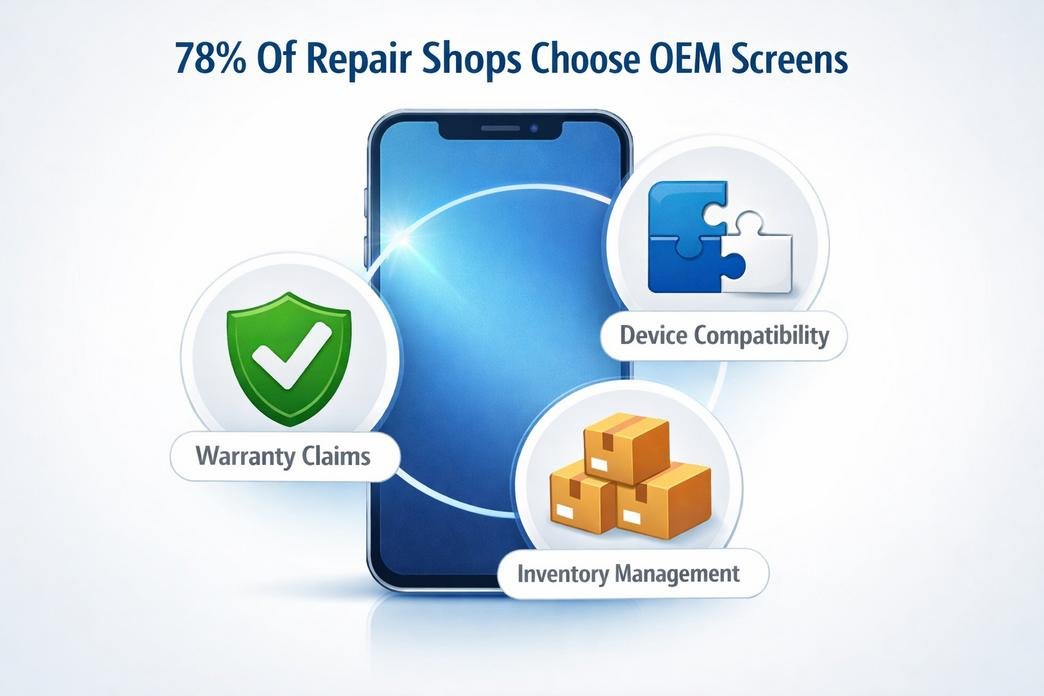
78% Of Repair Shops Choose OEM Screens
Choosing the right OLED Screen Replacement isn’t just about price. It affects callbacks, stock pressure, and how customers rate the job. When shops handle an OLED screen swap or full OLED display repair, quality shows fast. A reliable OLED Screen Replacement keeps devices stable and reduces after-fix headaches.
Troubleshooting warranty claims with factory-grade screens
When handling warranty claims, service teams often trace faults back to screen quality. With factory-grade screens, the workflow becomes clearer:
- Repair intake review
- Check brightness variance and touch lag.
- Compare results against service center protocols.
- Component diagnostics
- Validate flex cable integrity.
- Measure refresh rate stability tied to component reliability.
- Customer follow-up
- Log repeat visits impacting customer satisfaction.
- Flag trends affecting overall repair quality.
In many OLED Screen Replacement cases, unstable aftermarket panels trigger ghost touch or uneven luminance. Using factory-spec OLED screen parts cuts repeat repairs. Fewer disputes. Cleaner data. Better control of warranty claims.
Device compatibility and repair industry demand
Shops track three pressure points in the repair industry:
- Rising market demand for OLED Screen Replacement on flagship models.
- Growing model variations each year.
- Tighter component sourcing cycles.
Full device compatibility matters. An OLED display replacement that matches original calibration avoids software warnings and sensor errors. Cheap aftermarket alternatives sometimes fit, yet fail under heavy use.
Quick snapshot many techs share:
- Stable OLED screen response
- Accurate fingerprint sensor alignment
- No random dimming after updates
That’s why OEM-level OLED Screen Replacement stays in high rotation.
Inventory management advantages of original specification stock
Efficient inventory management links directly to profit. With original specification OLED Screen Replacement units, tracking gets simpler:
- Stock control layer
- Unified SKU under component standardization
- Lower obsolescence risk
- Supply chain layer
- Predictable reorder cycles
- Cleaner demand signals
- Warehouse efficiency layer
- Faster picking
- Fewer returns
Data from repair distributors shows the pattern:
| Metric | OEM Spec Avg | Mixed Aftermarket Avg | Variance % |
|---|---|---|---|
| Return Rate | 2.1% | 6.8% | +4.7% |
| SKU Duplication | 12 | 27 | +125% |
| Monthly Forecast Error | 4.5% | 11.2% | +6.7% |
Standardized OLED Screen Replacement stock keeps forecasting tight and shelves organized. Less chaos. More control.
5 Key Specs For Aftermarket OLED Screen Replacement
Choosing the right OLED Screen Replacement isn’t just about price. It’s about how the OLED, the screen, and the replacement assembly work together in daily use. A solid OLED display replacement should feel smooth, look sharp, and install without drama.
Resolution density and pixel arrangement
When evaluating an OLED Screen Replacement, start with resolution and pixel density. These define how crisp text and icons appear.
- Core metrics
- display resolution: overall pixel grid
- pixel per inch: sharpness per inch
- pixel count: total visible pixels
- Structural design
- sub-pixel layout
- RGB stripe
- Diamond matrix
- display density impact
- Higher density reduces jagged edges
- Balanced layout improves color blending
- sub-pixel layout
For an OLED screen replacement, mismatched display density can make apps look slightly off. At screen stocks, specs are clearly labeled so your OLED Screen Replacement aligns with factory standards.
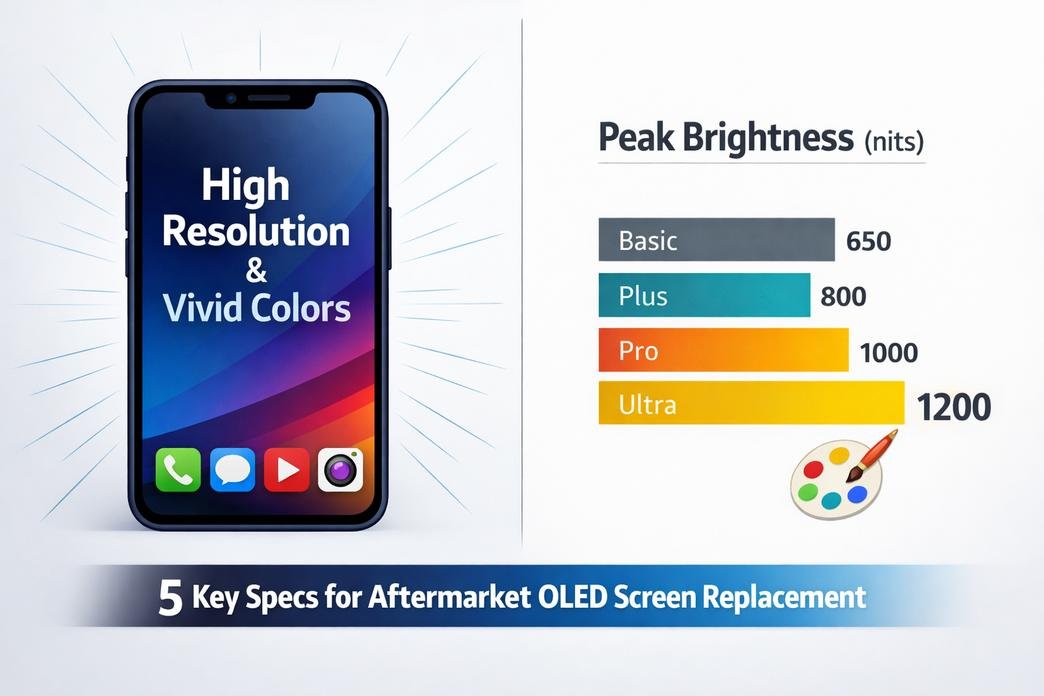
Brightness level and color gamut support
Outdoor use pushes an OLED display hard. Check peak brightness, nits, and luminance stability.
- Color control
- color gamut coverage
- DCI-P3 coverage
- sRGB coverage
- color depth
Below is a quick comparison for common OLED Screen Replacement grades:
| Grade | Peak Brightness (nits) | DCI-P3 Coverage (%) | sRGB Coverage (%) | Color Depth (bit) |
|---|---|---|---|---|
| Basic | 650 | 90 | 100 | 8 |
| Plus | 800 | 95 | 100 | 8 |
| Pro | 1000 | 99 | 100 | 10 |
| Ultra | 1200 | 100 | 100 | 10 |
A brighter OLED Screen Replacement improves visibility, but color accuracy keeps photos real.
Refresh rate vs. power consumption trade-offs
A high refresh rate (90Hz, 120Hz) boosts scrolling smoothness. Still, more Hz can mean higher energy consumption.
- Performance layer
- frame rate consistency
- adaptive refresh rate switching
- Efficiency layer
- power efficiency tuning
- Reduced battery drain
For heavy gamers, a 120Hz OLED display replacement feels slick. For daily chat and browsing, balanced settings protect battery life. Good OLED Screen Replacement units manage both.
Connector type and flex cable integration
Installation success depends on the right connector type and clean flex cable routing.
- Hardware alignment
- Confirm pin count
- Match interface standard
- Verify cable length
- Signal integrity
- Stable data transmission
- Strong cable compatibility
An incompatible connector can cause ghost touch or no display. Trusted suppliers like screen stocks test each OLED Screen Replacement for motherboard matching.
Frame attached vs. without-frame assembly formats
Choosing between formats affects repair speed and cost.
- frame assembly advantages
- Pre-aligned bezels
- Integrated display housing
- Better component alignment
- Without-frame option
- Lower upfront price
- Requires manual adhesive strips
- Higher installation skill
If you want quick turnaround, a pre-installed frame OLED Screen Replacement saves time. Skilled technicians may prefer bare panels for flexibility. Either way, the right OLED Screen Replacement keeps your device looking fresh and running clean.
OLED Screen Replacement Quality Checklist
A solid OLED Screen Replacement is more than just swapping a panel. It’s about getting every OLED screen, display assembly, and screen replacement detail right before it hits a customer’s phone. This checklist keeps OLED display replacement jobs smooth, reduces returns, and helps partners like screen stocks stay ahead in the OLED replacement game.
Pre-assembled rigid OLED vs. flexible display fit check
For every OLED Screen Replacement, confirm structural compatibility before installation.
- OLED panel type
- Check OLED panel type specification
- Compare rigid vs. flexible bend radius
- Confirm display curvature alignment
- Frame and housing match
- Inspect frame compatibility with device model
- Review mounting points placement accuracy
- Ensure component alignment along edges
- Sealing integrity
- Test adhesive seal integrity under light pressure
- Verify no lift along corners
- Confirm flush seating inside housing
A quick dry-fit of the OLED screen replacement unit saves hours later.
OEM equivalent digitizer responsiveness test
A proper OLED Screen Replacement must feel like the original.
- Validate touch sensitivity across the full panel
- Measure multi-touch accuracy at edge zones
- Screen for ghost touch detection during idle
Then move deeper:
- Swipe and tap validation
- Check swipe latency in fast scrolling
- Review tap precision on small icons
- Stylus and input review
- Confirm stylus input compatibility
- Test diagonal tracking stability
If the OLED display replacement lags, users notice instantly. screen stocks runs these checks before shipping bulk OLED screen units.
Integrated circuit inspection and pixel defect analysis
Every OLED Screen Replacement depends on stable electronics.
- Chip-level validation
- Confirm IC chip functionality
- Monitor display driver performance under brightness shifts
- Pixel integrity review
- Count dead pixel count
- Record stuck pixel assessment results
- Examine sub-pixel arrangement under magnification
- Visual consistency
- Compare color uniformity on grayscale patterns
- Measure brightness consistency edge to center
A clean OLED screen replacement should show zero distractions in daily use.
Packaging requirements for shipping container safety
Even the best OLED Screen Replacement fails if shipping goes wrong.
- Inner protection
- Use anti-static bag usage for each OLED screen
- Add protective foam inserts around corners
- Outer defense
- Perform impact resistance testing on cartons
- Apply moisture barrier layers for long transit
- Closure and marking
- Check secure closure mechanism
- Follow labeling standards
- Add clear fragile item marking
screen stocks ensures every OLED Screen Replacement leaves the warehouse protected, so each OLED replacement arrives ready to install, no drama attached.
Bulk Galaxy S25 Screen Replacement Steps
Bulk Galaxy S25 repairs are no joke. When you’re handling high-volume OLED Screen Replacement jobs, small mistakes add up fast. From sourcing OLED screens to final OLED display replacement checks, every move counts. Here’s how to keep your workflow tight and your margins healthy.
Step 1: wholesale procurement and supplier relationship setup
For large-scale OLED Screen Replacement operations, sourcing is the backbone.
- Procurement strategy
- Define monthly lead time management targets
- Align forecast with OLED screen replacement demand
- Supplier vetting
- Audit quality assurance protocols
- Verify OEM-equivalent AMOLED screen replacement standards
- Contract negotiation
- Lock pricing tiers
- Clarify communication channels
- Confirm payment cycles
Under strong supplier relationship terms, bulk buyers reduce risk. IDC noted in a 2025 mobile parts outlook:
“Aftermarket OLED display replacement demand continues to rise alongside premium device longevity trends.”
That trend keeps OLED Screen Replacement volume steady, especially when partnering with stable vendors like screen stocks for consistent batch supply.
Step 2: unpacking and inventory management verification
Once shipments land, control starts at the dock.
- Receiving inspection
- Check carton seals
- Log damage assessment photos
- Serial number tracking
- Record batch codes
- Sync with stock system
- Stock level reconciliation
- Match PO vs physical count
- Trigger discrepancy reporting if gaps appear
- Maintain correct storage conditions to protect each OLED screen.
Tight logging keeps every OLED Screen Replacement traceable from shelf to bench.
Step 3: frame removal and pre-assembled OLED alignment
Precision here protects your profit.
- Tool prep
- Calibrate disassembly tools
- Heat and complete careful adhesive removal
- Structural review
- Conduct frame integrity check
- Panel install
- Ensure correct OLED panel seating
- Confirm connector securement
- Guide clean flex cable routing
- Use a testing jig before sealing
A clean AMOLED screen replacement fit prevents callbacks and keeps each OLED Screen Replacement smooth.
Step 4: post-installation quality control and warranty terms recording
Quality control closes the loop.
- Run display functionality test
- Complete touch sensitivity verification
- Perform color accuracy check
- Conduct detailed pixel defect inspection
- Observe short-cycle battery drain monitoring
After testing, log warranty registration data and archive return policy documentation. Clear records protect your shop and reassure clients that every OLED Screen Replacement meets pro standards.
FAQs about OLED Screen Replacement
Why do factory grade OLED Screen Replacement units cost more than premium aftermarket options?
The price gap often reflects control, not branding.
- Factory grade / OEM equivalent panels
- Calibrated brightness level and color gamut before bulk shipment
- Stable integrated circuit performance and tighter pixel arrangement checks
- Backed by structured warranty terms and clearer return policy
- Premium aftermarket panels
- Lower wholesale procurement cost
- Wider variation in resolution density or refresh rate
- Less predictable replacement cycle in the repair industry
For repair shops handling high‑end consumer electronics, that difference can mean fewer callbacks and smoother inventory management.
How do quality control and logistics impact wholesale OLED pricing?
Behind every display panel is a chain of testing and transport pressure.
- Quality control stage
- Pixel and brightness level inspection on AMOLED and rigid OLED
- Touchscreen assembly and digitizer response validation
- Connector type and flex cable alignment checks for device compatibility
- Logistics stage
- Anti-static packaging requirements for flexible display safety
- Reinforced shipping container protection during bulk shipment
- Customs clearance fees tied to fragile electronic components
Each added checkpoint raises cost slightly, yet reduces risk across distribution networks and large-volume orders.
What should repair shops inspect before installing pre-assembled OLED Screen Replacement units?
A quick check can prevent long hours of rework.
- Confirm if the unit is frame attached or without frame, matching the housing.
- Test brightness level, refresh rate, and color gamut against original specification standards.
- Verify flex cable alignment and connector type before final touchscreen assembly sealing.







Recent Comments